


 |
To see how to obtain Fourier series for classical waveforms in
general, consider first the square wave,
![\begin{displaymath} x[n] = s[n] - s[n-{N \over 2}] \end{displaymath}](img1335.png)
 for the first half cycle (
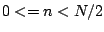 ) and
) and  for the rest. We
get the Fourier series by plugging in the Fourier series for
for the rest. We
get the Fourier series by plugging in the Fourier series for
![$s[n]$](img1311.png) twice:
twice:![\begin{displaymath} x[n] \approx {1 \over \pi} \left [ {\sin ( \omega n )} + ... ...\over 2} + {{\sin ( 3 \omega n)} \over 3} + \cdots \right . \end{displaymath}](img1337.png)
![\begin{displaymath} \left . -{\sin ( \omega n )} + {{\sin ( 2 \omega n)} \over 2} - {{\sin ( 3 \omega n)} \over 3} \pm \cdots \right ] \end{displaymath}](img1338.png)
![\begin{displaymath} = {2 \over \pi} \left [ {\sin ( \omega n )} + {{\sin ( 3 ... ...\over 3} + {{\sin ( 5 \omega n)} \over 5} + \cdots \right ] \end{displaymath}](img1339.png)
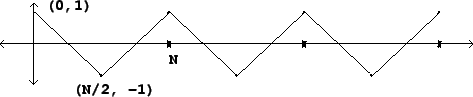
The symmetric triangle wave (Figure 10.6) given by
![\begin{displaymath} x[n] = 8 p[n] - 8 p[n-{N \over 2}] \end{displaymath}](img1340.png)
![\begin{displaymath} x[n] \approx {8 \over {{\pi^2}}} \left [ {\cos ( \omega n ... ...over 9} + {{\cos ( 5 \omega n)} \over 25} + \cdots \right ] \end{displaymath}](img1341.png)
 pairs equal to
  and
and
 .
.