


In the wavetable formulation, a pulse train can be made by a
stretched wavetable:
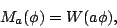
 is the phase, i.e., the
value
is the phase, i.e., the
value  wrapped to lie between
  and
and  . The function
  should be
zero at and beyond the points and , and rise to a maximum at 0. A possible choice for the
function is
should be
zero at and beyond the points and , and rise to a maximum at 0. A possible choice for the
function is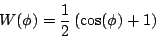
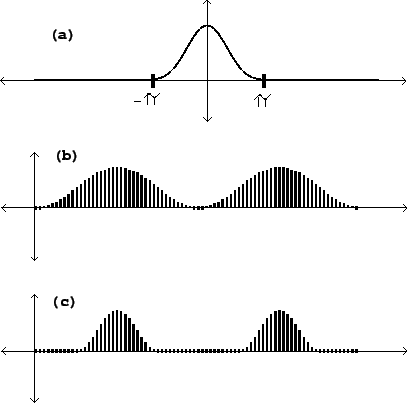 |
Realizing this as a repeating waveform, we get a succession of
(appropriately sampled) copies of the function ,
whose duty cycle is  (parts b and c of the
figure). If you don't wish the copies to overlap the index
(parts b and c of the
figure). If you don't wish the copies to overlap the index
 must be at least 1. If you want to allow
overlap the simplest strategy is to duplicate the block diagram
(Figure 6.3) out of phase, as
described in Section 2.4
and realized in Section 2.6.
must be at least 1. If you want to allow
overlap the simplest strategy is to duplicate the block diagram
(Figure 6.3) out of phase, as
described in Section 2.4
and realized in Section 2.6.
 ; (b) the function as
a waveform, repeated at a duty cycle of 100% (modulation index
; (b) the function as
a waveform, repeated at a duty cycle of 100% (modulation index
 ); (c) the waveform at a 50% duty cycle
(
); (c) the waveform at a 50% duty cycle
( ).
).