


Two amplitudes are often best compared using their ratio rather
than their difference. For example, saying that one signal's
amplitude is greater than another's by a factor of two is more
informative than saying it is greater by 30 millivolts. This is
true for any measure of amplitude (RMS or peak, for instance). To
facilitate this we often express amplitudes in logarithmic units
called decibels. If  is
an amplitude in any linear scale (such as above) then we can define
the decibel (dB) amplitude
is
an amplitude in any linear scale (such as above) then we can define
the decibel (dB) amplitude  as:
as:
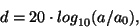
 is a reference amplitude. This definition
is set up so that, if we increase the signal power by a factor of
ten (so that the amplitude increases by a factor of
is a reference amplitude. This definition
is set up so that, if we increase the signal power by a factor of
ten (so that the amplitude increases by a factor of  ), the logarithm will increase by
  ,
and so the value in decibels goes up (additively) by ten. An
increase in amplitude by a factor of two corresponds to an increase
of about 6.02 decibels; doubling power is an increase of 3.01 dB.
In dB, therefore, adding two uncorrelated signals of equal
amplitude results in one that is about 3 dB higher, whereas
doubling a signal increases its amplitude by 6 dB.
,
and so the value in decibels goes up (additively) by ten. An
increase in amplitude by a factor of two corresponds to an increase
of about 6.02 decibels; doubling power is an increase of 3.01 dB.
In dB, therefore, adding two uncorrelated signals of equal
amplitude results in one that is about 3 dB higher, whereas
doubling a signal increases its amplitude by 6 dB.
Still using as a reference amplitude, a signal
with linear amplitude smaller than will have a
negative amplitude in decibels:  gives -20 dB,
 gives -40, and so on. A linear
amplitude of zero is smaller than that of any value in dB, so we
give it a dB value of
gives -40, and so on. A linear
amplitude of zero is smaller than that of any value in dB, so we
give it a dB value of  .
.
In digital audio a convenient choice of reference, assuming the
hardware has a maximum amplitude of one, is

Amplitude is related in an inexact way to perceived loudness of a sound. In general, two signals with the same peak or RMS amplitude won't necessarily have the same loudness at all. But amplifying a signal by 3 dB, say, will fairly reliably make it sound about one "step" louder. Much has been made of the supposedly logarithmic responses of our ears (and other senses), which may indeed partially explain why decibels are such a popular scale of amplitude.
Amplitude is also related in an inexact way to musical dynamic. Dynamic is better thought of as a measure of effort than of loudness or power, and the scale moves, roughly, over nine values: rest, ppp, pp, p, mp, mf, f, ff, fff. These correlate in an even looser way with the amplitude of a signal than does loudness [RMW02, pp. 110-111].