


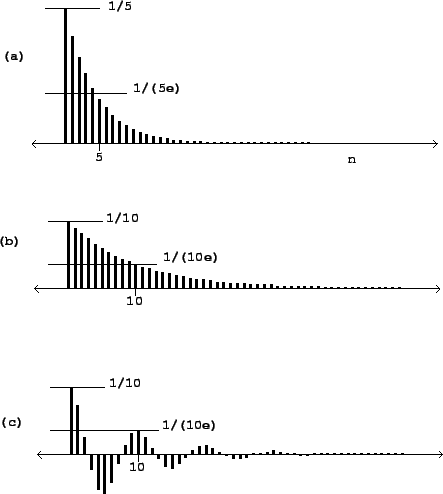
In Section 7.4 we derived the impulse response of a recirculating comb filter, of which the one-pole low-pass filter is a special case. In Figure 8.22 we show the result for two low-pass filters and one complex one-pole resonant filter. All are elementary recirculating filters as introduced in section 8.2.3. Each is normalized to have unit maximum gain.
In the case of a low-pass filter, the impulse
response gets longer (and lower) as the pole gets closer to one.
Suppose the pole is at a point  (so that the
cutoff frequency is
(so that the
cutoff frequency is  radians). The normalizing
factor is also . After
radians). The normalizing
factor is also . After  points,
the output diminishes by a factor of
points,
the output diminishes by a factor of
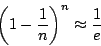
 is Euler's constant, about
2.718. The filter can be said to have a settling time of samples. In
the figure,
is Euler's constant, about
2.718. The filter can be said to have a settling time of samples. In
the figure,  for part (a) and
  for part (b). In general, the settling time (in samples)
is approximately one over the cutoff frequency (in angular
units).
for part (b). In general, the settling time (in samples)
is approximately one over the cutoff frequency (in angular
units).
 |
The situation gets more interesting when we look
at a resonant one-pole filter, that is, one whose pole lies off the
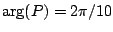
real axis. In part (c) of the figure, the pole  has absolute value 0.9 (as in part (b)), but its argument is set to
 radians. We get the same settling
time as in part (b), but the output rings at the resonant frequency
(and so at a period of 10 samples in this example).
radians. We get the same settling
time as in part (b), but the output rings at the resonant frequency
(and so at a period of 10 samples in this example).
A natural question to ask is, how many periods
of ringing do we get before the filter decays to strength
 ? If the pole of a resonant has modulus
as above, we have seen in section
8.2.3 that the
bandwidth (call it
? If the pole of a resonant has modulus
as above, we have seen in section
8.2.3 that the
bandwidth (call it  ) is about , and we have seen here that the settling time is about
. The resonant frequency (call it
) is about , and we have seen here that the settling time is about
. The resonant frequency (call it  ) is the argument of the pole, and the period in
samples is
) is the argument of the pole, and the period in
samples is  . The number of periods
that make up the settling time is thus:
. The number of periods
that make up the settling time is thus:
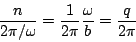
 is the quality of the filter, defined as the center
frequency divided by bandwidth. Resonant filters are often
specified in terms of the center frequency and ``q", instead of
bandwidth.
is the quality of the filter, defined as the center
frequency divided by bandwidth. Resonant filters are often
specified in terms of the center frequency and ``q", instead of
bandwidth.
 ; (b) low-pass with
  ; (c) band-pass,
with
; (c) band-pass,
with  and
and
 .
.