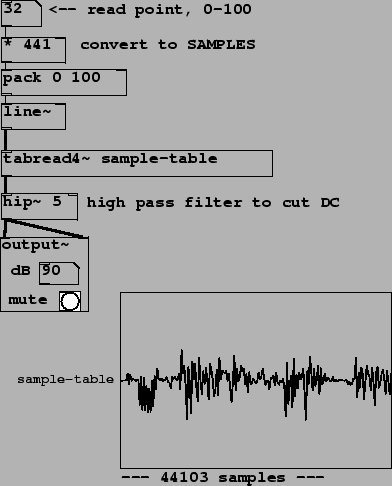
Patch B04.sampler.pd (Figure 2.14) shows how to use a wavetable as a sampler. In
this case the index into the sample (the wavetable) is controlled
by mousing on a number box at top. A convenient scaling for the
number box is hundredths of a second; to convert to samples (as the
input of tabread4~ requires) we multiply by 44100
samples/sec times 0.01 sec to get 441 samples per unit, before
applying pack and line~ in much the same
way as they were used in the previous example. The transposition
you hear depends on how quickly you mouse up and down. This example
has introduced one new object class:
 : simple high-pass (low-cut) filter. The creation
argument gives the rolloff frequency in cycles per second. We use
it here to eliminate the constant (zero-frequency) output when the
input sits in a single sample (whenever you aren't actively
changing the wavetable reading location with the mouse.) Filters
are discussed in chapter 8.
: simple high-pass (low-cut) filter. The creation
argument gives the rolloff frequency in cycles per second. We use
it here to eliminate the constant (zero-frequency) output when the
input sits in a single sample (whenever you aren't actively
changing the wavetable reading location with the mouse.) Filters
are discussed in chapter 8.
The pack and line~ in
this example are not merely to make the sound more continuous, but
are essential to making the sound intelligible at all. If the index
into the wavetable lookup simply changed every time the mouse moved
a pixel (say, twenty to fifty times a second) the overwhelming
majority of samples would get the same index as the previous sample
(the other 44000+ samples, not counting the ones where the mouse
moved.) So the speed of precession would almost always be zero.
Instead of changing transpositions, you would hear 20 to 50
cycles-per-second grit. (Try it to find out what that sounds
like!)