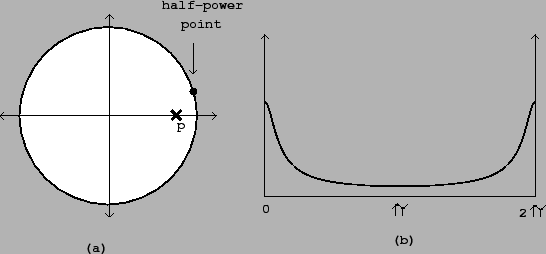
The one-pole low-pass filter has a single pole
located at a positive real number  , as pictured
in Figure 8.12. This is just a
recirculating comb filter with delay length
, as pictured
in Figure 8.12. This is just a
recirculating comb filter with delay length  , and
the analysis of section 7.4 applies. The maximum
gain occurs at a frequency of zero, corresponding to the point on
the circle closest to the point . The gain there is
, and
the analysis of section 7.4 applies. The maximum
gain occurs at a frequency of zero, corresponding to the point on
the circle closest to the point . The gain there is
 . If we move a distance of
  units up or down from the real (horizontal) axis, the
distance increases by a factor of about
units up or down from the real (horizontal) axis, the
distance increases by a factor of about  , and
so we expect the half-power point to occur at an angular frequency
of about .
, and
so we expect the half-power point to occur at an angular frequency
of about .
This calculation is often made in reverse: if we
wish the half-power point to lie at a given angular frequency
 , we set
  .
This approximation only works well if the value of is well under
.
This approximation only works well if the value of is well under  , as it usually
is in practice.
, as it usually
is in practice.
It is customary to normalize the one-pole
lowpass filter, multiplying it by the constant factor in order to give a gain of 1 at zero frequency; nonzero
freqencies will then get a gain less than one.
The frequency response is graphed in Figure
8.12 part (b). The audible frequencies only
reach to the middle of the graph; the right-hand side of the
frequency response curve all lies above the Nyquist frequency
 .
.
The one-pole lowpass filter is often used to smooth noisy signals to seek slow-moving trends in them. For instance, if you use a physical controller and care about changes on the order of 1/10 second or so, you can smooth the control by using a low-pass filter whose half-power point is 20 or 30 cycles per second.