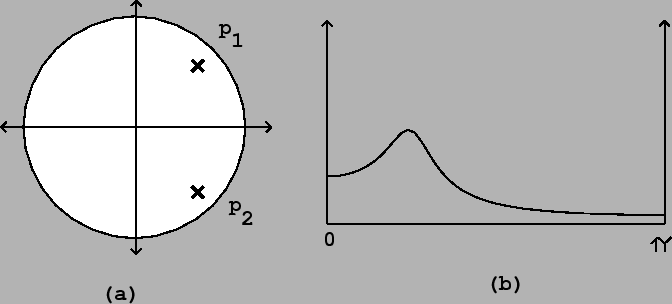
Taking the filter types shown above, which all
have real-valued poles and zeros, we now transform them to operate
on bands located off the real axis. The low-pass, high-pass, and
shelving filters will then become band-pass, band-stop, and peaking
filters. First we will develop the band-pass filter. Suppose we
want a center frequency at  radians, and a
bandwidth of
radians, and a
bandwidth of  . We take the low-pass filter with
cutoff frequency ; its pole is located, for small
calues of , roughly at
. We take the low-pass filter with
cutoff frequency ; its pole is located, for small
calues of , roughly at  . Now rotate this value by radians in the complex plane, by multiplying by the
complex number
. Now rotate this value by radians in the complex plane, by multiplying by the
complex number
 . The new pole is
at:
. The new pole is
at:


The peak is approximately (not exactly) at the
desired center frequency and the 3-dB points
approximately radians above and below it. It is
often desirable to normalize the filter to have a peak gain near
unity; this is done by multiplying the input or output by the
product of the distances of the two poles to the peak on the
circle, or (very approximately):

 and
and  , so that the gain
drops to zero at angular frequencies
, so that the gain
drops to zero at angular frequencies  and
and
 .
.