


A filter with one real pole and one real zero
can be configured as a shelving filter, as a high-pass filter
(putting the zero at the point  ) or as a low-pass
filter (putting the zero at
) or as a low-pass
filter (putting the zero at  ). The frequency
responses of these filters are quite blunt; in other words, the
transition regions are wide. It is often desirable to get a sharper
filter, either shelving, low- or high-pass, whose two bands are
flatter and separated by a narrower transition region.
). The frequency
responses of these filters are quite blunt; in other words, the
transition regions are wide. It is often desirable to get a sharper
filter, either shelving, low- or high-pass, whose two bands are
flatter and separated by a narrower transition region.
A procedure borrowed from the analog filtering world transforms real, one-pole, one-zero filters to corresponding Butterworth filters, which have narrower transition regions. This procedure is described clearly and elegantly in the last chapter of []. Since it involves passing from the discrete-time to the continuous-time domain, the derivation uses calculus; it also requires using notions of complex exponentiation and roots of unity which we are avoiding here.
To make a Butterworth filter out of a high-pass,
low-pass, or shelving filter, suppose that either the pole or the
zero is given by the expression

 is a parameter ranging from
1 to
is a parameter ranging from
1 to  . If
. If  this is the point
, and if
this is the point
, and if  it's
.
it's
.
Then, for reasons which will remain mysterious,
we replace the point (whether pole or zero) by  points given by:
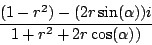
 ranges over the
values:
ranges over the
values: takes on
equally spaced angles between
takes on
equally spaced angles between  and
and  . The points are arranged in the
complex plane as shown in Figure 8.17. They
lie on a circle through the original real-valued point, which cuts
the unit circle at right angles.
. The points are arranged in the
complex plane as shown in Figure 8.17. They
lie on a circle through the original real-valued point, which cuts
the unit circle at right angles.
A good choice for a nominal cutoff or shelving
frequency defined by these circular collections of poles or zeros
is simply the spot where the circle intersects the unit circle,
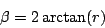
corresponding to
 . This gives the
point
. This gives the
point

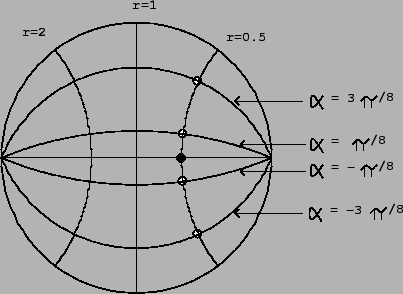 |
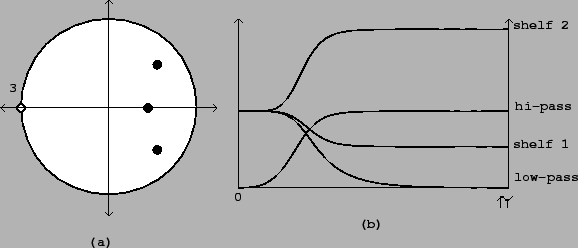
Figure 8.18, part (a),
shows a pole-zero diagram and frequency response for a Butterworth
low-pass filter with three poles and three zeros. Part (b) shows
the frequency response of the low-pass filter and three other
filters obtained by choosing different values of  (and hence ) for the zeros, while
leaving the poles stationary. As the zeros progress from
(and hence ) for the zeros, while
leaving the poles stationary. As the zeros progress from
 to
to  , the
filter, which starts as a low-pass filter, becomes a shelving
filter and then a high-pass one.
, the
filter, which starts as a low-pass filter, becomes a shelving
filter and then a high-pass one.
 |
 .
. . (b). Frequency responses for
four filters with the same pole configuration, with different
placements of zeros (but leaving the poles fixed). The low-pass
filter results from setting
. (b). Frequency responses for
four filters with the same pole configuration, with different
placements of zeros (but leaving the poles fixed). The low-pass
filter results from setting  and
and  , and finally
the high-pass filter is obtained setting
, and finally
the high-pass filter is obtained setting