


Suppose ![$X[n]$](img713.png) is a
complex-valued signal with period
is a
complex-valued signal with period  , a positive
integer. (We are using complex-valued signals rather than
real-valued ones because the mathematics will turn out simpler.)
The values of for
, a positive
integer. (We are using complex-valued signals rather than
real-valued ones because the mathematics will turn out simpler.)
The values of for
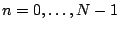 (one period) determine
for all integer values of
(one period) determine
for all integer values of  .
.
Suppose further that can be
written as a sum of sinusoids of frequency  ,
,
 ,
,  ,
,  ,
,  . These are the partials,
starting with the zeroth, for a signal of period . We
stop after the th partial because the next one would
have frequency
. These are the partials,
starting with the zeroth, for a signal of period . We
stop after the th partial because the next one would
have frequency  , equivalent to frequency
, which is already on the list.
, equivalent to frequency
, which is already on the list.
Given the values of  , we wish to
find the complex amplitudes of the partials. Suppose we want the
, we wish to
find the complex amplitudes of the partials. Suppose we want the
 th partial, where
  . The frequency of the partial is
 . We can get its amplitude
by modulating downward
. We can get its amplitude
by modulating downward  radians
per sample in frequency, so that the th partial is
modulated to frequency zero. Then we pass the signal through a
low-pass filter with such a low cutoff frequency that nothing but
the zero-frequency partial remains. Such a filter will essentially
average the samples of its periodic input. In
summary, to measure a sinusoidal component of a periodic signal,
modulate it down to DC and then average over one period.
radians
per sample in frequency, so that the th partial is
modulated to frequency zero. Then we pass the signal through a
low-pass filter with such a low cutoff frequency that nothing but
the zero-frequency partial remains. Such a filter will essentially
average the samples of its periodic input. In
summary, to measure a sinusoidal component of a periodic signal,
modulate it down to DC and then average over one period.
Let  be the unit-magnitude
complex number with argument (the
fundamental frequency of a signal with period ):
be the unit-magnitude
complex number with argument (the
fundamental frequency of a signal with period ):
 th partial of the signal
is of the form:
th partial of the signal
is of the form:![\begin{displaymath} {P_k}[n] = {A_k}{{\left [ {U^k} \right ]} ^ {n}} \end{displaymath}](img1096.png)
 is the complex
amplitude of the partial, and the frequency of the partial
is:
is the complex
amplitude of the partial, and the frequency of the partial
is: can actually be written as a sum of the
partials, or in other words:
can actually be written as a sum of the
partials, or in other words:![\begin{displaymath} X[n] = {P_0}[n] + {P_1}[n] + \cdots + {P_{N-1}}[n] \end{displaymath}](img1099.png)
![\begin{displaymath} = {A_0}{{\left [ {U^0} \right ]} ^ {n}} + {A_1}{{\left [ {... ...n}} + \cdots + {A_{N-1}}{{\left [ {U^{N-1}} \right ]} ^ {n}} \end{displaymath}](img1100.png)
 by
multiplying by the sinusoid of frequency
by
multiplying by the sinusoid of frequency  and averaging over a period:
![\begin{displaymath} {A_k} = {1\over N} \left ( {{\left [ {U^{-k}} \right ]} ^ ... ...dots + {{\left [ {U^{-k}} \right ]} ^ {N-1}} X[N-1] \right ) \end{displaymath}](img1103.png) , over samples, is defined
as:
, over samples, is defined
as:![\begin{displaymath} {\cal FT}\left \{ X[n] \right \} (k) = {V ^ {0}} X[0] + {V ^ {1}} X[1] + \cdots + {V ^ {N-1}} X[N-1] \end{displaymath}](img1104.png)
 . The Fourier
transform is a function of the variable . So far
has taken integer values but the formula
makes sense for any value of if we define
. The Fourier
transform is a function of the variable . So far
has taken integer values but the formula
makes sense for any value of if we define
 more carefully as:
 is the angular frequency associated with the
period .
is the angular frequency associated with the
period .