


We can use the phase shift formula above to find
the Fourier transform of any complex sinusoid  with frequency
  , simply by
setting
, simply by
setting ![$X[n]=1$](img1121.png) in the formula and using the Fourier
transform for DC:
in the formula and using the Fourier
transform for DC:

![\begin{displaymath} = \left [ \cos(\Phi(k) + i \sin(\Phi(k))\right ] {D_N}(k + {{\alpha } \over {\omega}}) \end{displaymath}](img1160.png)
 is the Dirichlet kernel
and
is the Dirichlet kernel
and  is an ugly phase term:
If the sinusoid's frequency is an integer multiple of the fundamental frequency
 , the Dirichlet kernel is shifted by an
integral value. In this case the zero crossings of the Dirichlet
kernel line up with integer values of
, the Dirichlet kernel is shifted by an
integral value. In this case the zero crossings of the Dirichlet
kernel line up with integer values of  , so that only
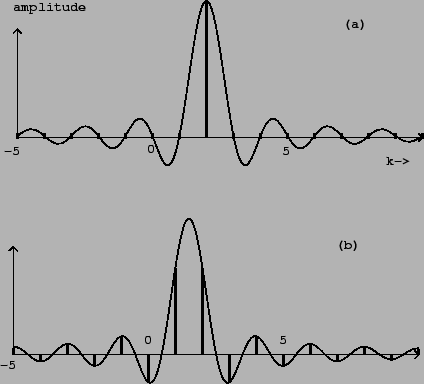
one partial is nonzero. This is pictured in Figure 9.3 part (a).
, so that only
one partial is nonzero. This is pictured in Figure 9.3 part (a).
 |
Part (b) shows the result when the frequency
falls halfway between two integers. The
partials have amplitudes falling off roughly as  in both directions, measured from the actual frequency . That the energy should be spread over many partials,
when after all we started with a single sinusoid, might seem
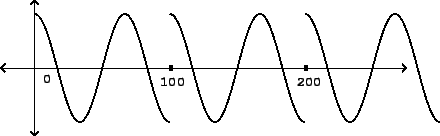
surprising at first. However, as shown in Figure 9.4, the signal repeats at a period
in both directions, measured from the actual frequency . That the energy should be spread over many partials,
when after all we started with a single sinusoid, might seem
surprising at first. However, as shown in Figure 9.4, the signal repeats at a period  which disagrees with the frequency of the sinusoid. As a result
there is a discontinuity at the beginning of each
period.
which disagrees with the frequency of the sinusoid. As a result
there is a discontinuity at the beginning of each
period.
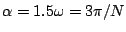
 ; (b)
; (b)  .
.
 , forced to repeat
every
, forced to repeat
every