


Fourier analysis can sometimes be used to
resolve the component sinusoids in an audio signal. Even when it
can't go that far, it can separate a signal into frequency regions,
in the sense that for each  , the th
point of the Fourier transform would be affected only by components
close to the nominal frequency
, the th
point of the Fourier transform would be affected only by components
close to the nominal frequency  . This
suggests many interesting operations we could perform on a signal
by taking its Fourier transform, transforming the results, and then
reconstructing a new, transformed, signal from the modified
transform.
. This
suggests many interesting operations we could perform on a signal
by taking its Fourier transform, transforming the results, and then
reconstructing a new, transformed, signal from the modified
transform.
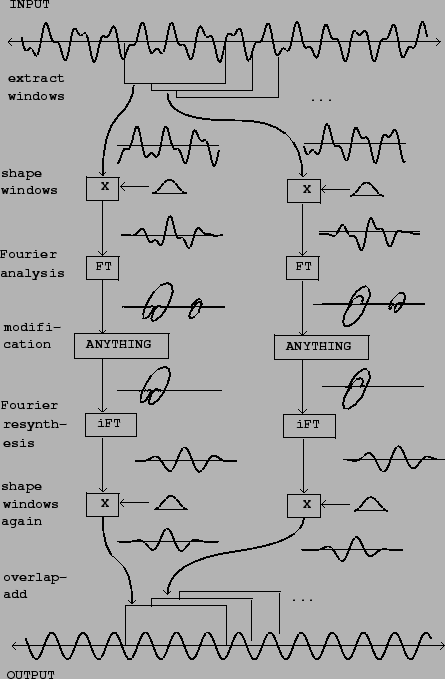 |
Figure 9.7 shows how to
carry out a Fourier analysis, modification, and reconstruction of
an audio signal. The first step is to divide the signal into
windows, which are segments
of the signal, of  samples each, usually with
some overlap. Each window is then shaped by multiplying it by a
windowing function (Hann, for example). Then the Fourier transform
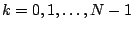
is calculated for the points
samples each, usually with
some overlap. Each window is then shaped by multiplying it by a
windowing function (Hann, for example). Then the Fourier transform
is calculated for the points
 . (Sometimes it is
desirable to calculate the Fourier transform for more points than
this, but these points will suffice here.)
. (Sometimes it is
desirable to calculate the Fourier transform for more points than
this, but these points will suffice here.)
The Fourier analysis gives us a two-dimensional
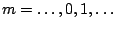
array of complex numbers. Let  denote the number of
samples each window is advanced past the previous window. Then for
each
denote the number of
samples each window is advanced past the previous window. Then for
each
 , the
, the  th window consists of the points starting at
the point
th window consists of the points starting at
the point  . The
. The  th point of the
th window is
th point of the
th window is  . The
windowed Fourier transform is thus equal to:
. The
windowed Fourier transform is thus equal to:
![\begin{displaymath} S[m, k] = {\cal FT}(W(n)X[n-mH]) (k) \end{displaymath}](img1194.png) ,
in units of samples) and of frequency (, as a multiple of the fundamental frequency
,
in units of samples) and of frequency (, as a multiple of the fundamental frequency  ). Fixing the frame number and looking
at the windowed Fourier transform as a function of :
). Fixing the frame number and looking
at the windowed Fourier transform as a function of :![\begin{displaymath} S[k] = S[m, k] \end{displaymath}](img1195.png)
![$X[n]$](img713.png) . On the other hand, fixing a frequency
we can look at it as the th
channel of an -channel signal:
. On the other hand, fixing a frequency
we can look at it as the th
channel of an -channel signal:![\begin{displaymath} C[m] = S[m, k] \end{displaymath}](img1196.png) into
narrow frequency regions, or bands.
into
narrow frequency regions, or bands.
Having computed the windowed Fourier transform, we next apply any desired modification. In the figure, the modification is simply to replace the upper half of the spectrum by zero, which gives a highly selective low-pass filter. Two other possible modifications, narrow-band companding and vocoding, are described in the following sections.
Finally we reconstruct an output signal. To do this we apply the inverse of the Fourier transform (labeled ``iFT" in the figure). As shown in Section 9.1.1 this can be done by taking another Fourier transform, normalizing, and flipping the result backwards. In case the reconstructed window does not go smoothly to zero at its two ends, we apply the Hann windowing function a second time. Doing this to each successive window of the input, we then add the outputs, using the same overlap as for the analysis.
If we use the Hann window and an overlap of four
(that is, choose a multiple of four and space each
window  samples past the previous one), we can
reconstruct the original signal faithfully by omitting the
``modification" step. This is because the iFT undoes the work of
the
samples past the previous one), we can
reconstruct the original signal faithfully by omitting the
``modification" step. This is because the iFT undoes the work of
the  , and so we are multiplying each window by
the Hann function squared. The output is thus the input, times the
Hann window function squared, overlap-added by four. An easy check
shows that this comes to the constant
, and so we are multiplying each window by
the Hann function squared. The output is thus the input, times the
Hann window function squared, overlap-added by four. An easy check
shows that this comes to the constant  , so the
output equals the input adjusted by a gain factor.
, so the
output equals the input adjusted by a gain factor.
The ability to reconstruct the input signal exactly is useful because some types of modification may be done by degrees, and so the output can be made to vary smoothly between the input and some transformed version of it.