


Before making a quantitative analysis of the Fourier series of the classical waveforms, we pause to make two useful observations about symmetries in waveforms and the corresponding symmetries in the Fourier series. First, a Fourier series may consist only of even or odd-numbered harmonics; this will be reflected in symmetries comparing a waveform to its displacement by half a cycle. Second, the Fourier series may contain only real- or pure imaginary-valued coefficients (corresponding to the cosine or sine functions). This is reflected in symmetries comparing the waveform to its reversal in time.
In this section we will assume that our waveform
has an integer period  , and furthermore, for
simplicity, that is even (if it isn't we can just
up-sample by a factor of two). We know from chapter 9 that any
(real or complex valued) waveform
, and furthermore, for
simplicity, that is even (if it isn't we can just
up-sample by a factor of two). We know from chapter 9 that any
(real or complex valued) waveform ![$X[n]$](img713.png) is equal
to its Fourier series (whose coefficients we'll denote by
is equal
to its Fourier series (whose coefficients we'll denote by
![$Y[k]$](img1112.png) ):
):
![\begin{displaymath} X[n] = Y[0] + Y[1]{U^n} + \cdots + Y[N-1]{U^{(N-1)n}} \end{displaymath}](img1293.png)
![\begin{displaymath} X[n] = Y[0] + Y[1](\cos(\omega n) + i \sin(\omega n)) + \cdots \end{displaymath}](img1294.png)
 n) + i \sin(\omega (N-1) n)) \end{displaymath}](img1295.png)
 is the fundamental frequency
of the waveform, and
is the fundamental frequency
of the waveform, and
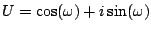 is the
unit-magnitude complex number whose argument is
is the
unit-magnitude complex number whose argument is  .
.
To analyze the first symmetry we delay the
signal by a half-cycle. Since
 we get:
![\begin{displaymath} X[n+N/2] = Y[0] - Y[1]{U^n} + Y[2]{U^{2n}} \pm \cdots \end{displaymath}](img1298.png)
![\begin{displaymath} + Y[N-2]{U^{(N-2)n}} - Y[N-1]{U^{(N-1)n}} \end{displaymath}](img1299.png)
 denote half the sum of the
two:
denote half the sum of the
two:![\begin{displaymath} X'[n] = {{X[n] + x[n+N/2]}\over 2} = Y[0] + Y[2]{U^{2n}} + \cdots + Y[N-2]{U^{(N-2)n}} \end{displaymath}](img1301.png)
 the
difference:
the
difference:![\begin{displaymath} X''[n] = {{X[n] - x[n+N/2]}\over 2} = Y[1]{U^n} + Y[3]{U^{3n}} + \cdots + Y[N-1]{U^{(N-1)n}} \end{displaymath}](img1303.png) consists only of
even-numbered harmonics (including DC) and only
of odd ones.
consists only of
even-numbered harmonics (including DC) and only
of odd ones.
Furthermore, if  happens to
equal itself shifted a half cycle, that is, if
happens to
equal itself shifted a half cycle, that is, if
![$X[n] = X[n+N/2]$](img1304.png) , then looking at the
definition of we get
, then looking at the
definition of we get ![$X'[n] = X[n]$](img1305.png) and
and ![$X''[n] = 0$](img1306.png) . This implies that, in this case,
has only even numbered harmonics.
Indeed, this should be no surprise, since in this case would have to repeat every
. This implies that, in this case,
has only even numbered harmonics.
Indeed, this should be no surprise, since in this case would have to repeat every  samples,
so its fundamental frequency is twice as high than in general for
period .
samples,
so its fundamental frequency is twice as high than in general for
period .
In the same way, if
![$X[n] = -X[n+N/2$](img1308.png) , then
can have only odd-numbered harmonics. This allows us easily to
split any desired waveform into its even- and odd-numbered
harmonics. (This is equivalent to using a comb filter to extract
even or odd harmonics; see Chapter 7.)
, then
can have only odd-numbered harmonics. This allows us easily to
split any desired waveform into its even- and odd-numbered
harmonics. (This is equivalent to using a comb filter to extract
even or odd harmonics; see Chapter 7.)
For the second symmetry we compare with its time reversal, ![$X[-n]$](img1309.png) (or.
equivalently, since repeats every samples, with
(or.
equivalently, since repeats every samples, with ![$X[N-n]$](img1310.png) ). The Fourier series
becomes:
). The Fourier series
becomes:
![\begin{displaymath} X[-n] = Y[0] + Y[1](\cos(\omega n) - i \sin(\omega n)) + \cdots \end{displaymath}](img1311.png)
 n) - i \sin(\omega (N-1) n)) \end{displaymath}](img1312.png)
![$X'[n]$](img1313.png) as half the
sum:
as half the
sum:![\begin{displaymath} X'[n] = {{X[n] + X[-n]}\over 2} = Y[0] + Y[1]\cos(\omega n)+ \cdots + Y[N-1]\cos(\omega (N-1) n) \end{displaymath}](img1314.png)
![$X''[n]$](img1315.png) as half the difference
over
as half the difference
over  :
:![\begin{displaymath} X'[n] = N {{X[n] + X[-n]}\over {2i}} = Y[1]\sin(\omega n)+ \cdots + Y[N-1]\sin(\omega (N-1) n) \end{displaymath}](img1316.png) satisfies
satisfies ![$X[-n] = X[n]$](img1317.png) the sinusoidal components are all cosines; and if
the sinusoidal components are all cosines; and if
![$X[-n] = -X[n]$](img1318.png) they are all sines; and as
before we can decompose any (that repeats
every samples) into the two.
they are all sines; and as
before we can decompose any (that repeats
every samples) into the two.