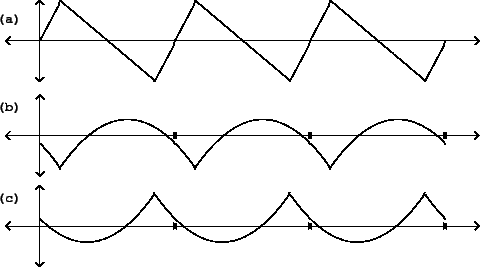
Among the several conclusions we can draw from the even/odd harmonic decomposition of the sawtooth wave (Figure 10.2), one is that a square wave can be decomposed into a linear combination of two sawtooth waves. We can carry this idea further, and show how to compose any classical waveform having only jumps (discontinuities in value) but no corners (discontinuities in slope) as a sum of sawtooth waves of various phases and amplitudes. We then develop the idea further, showing how to generate waveforms with corners (either in addition to, or instead of, jumps) using another fundamental waveform we'll call the parabolic wave.
Suppose first that a waveform of period
 has discontinuities at
  different points,
 , all lying on the cycle
between 0 and , at which the waveform jumps by values
, all lying on the cycle
between 0 and , at which the waveform jumps by values
 . A negative value of
 , for instance, would mean that the
waveform jumps from a higher to a lower value at the point
, for instance, would mean that the
waveform jumps from a higher to a lower value at the point
 , and a positive value of would mean a jump from a lower to a higher
value.
, and a positive value of would mean a jump from a lower to a higher
value.
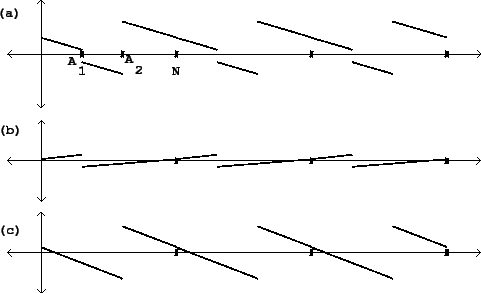 |
For instance, Figure 10.3 shows (part a) a classical waveform with two
jumps:
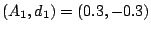 and
and
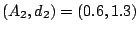 . Parts (b) and
(c) show sawtooth waves which each has one of the two jumps. The
sum of the two sawtooth waves reconstructs the waveform of part
(a), except for a possible constant (DC) offset.
. Parts (b) and
(c) show sawtooth waves which each has one of the two jumps. The
sum of the two sawtooth waves reconstructs the waveform of part
(a), except for a possible constant (DC) offset.
The sawtooth wave with a jump of one unit at the
point zero is given by
![\begin{displaymath} s[n] = n/N - 1/2 \end{displaymath}](img1327.png)
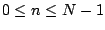 , and repeats for other
values of
, and repeats for other
values of  . A sawtooth wave with a jump at
 is given by
![$s'[n] = d s[n-A]$](img1330.png) . The sum of all the
sawtooth waves necessary would be:
. The sum of all the
sawtooth waves necessary would be:![\begin{displaymath} x[n] = {d_1} s[n - {A_1}] + \cdots + {d_j} s[n - {A_j}] \end{displaymath}](img1331.png)
The slopes of the segments of the classical
waveform of part (a) are all equal, and equal the sum of the slopes
of the component sawtooth waves, equal in general to
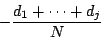
 .
.
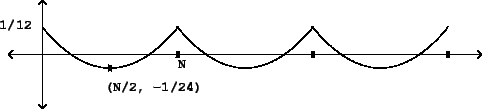
To decompose classical waveforms with corners we
use the parabolic wave, which, over a single period from 0 to
, is equal to
![\begin{displaymath} p[n] = {{({n\over N} - {1\over 2})}^2}/2 - 1/24 \end{displaymath}](img1335.png) , arranged so that it reaches a maximum
halfway through the cycle at
, arranged so that it reaches a maximum
halfway through the cycle at  , the DC
component is zero (or in other words, the average value over one
cycle of the waveform is zero), and so that the slope changes
discontinuously by
, the DC
component is zero (or in other words, the average value over one
cycle of the waveform is zero), and so that the slope changes
discontinuously by  at the beginning of the
cycle.
at the beginning of the
cycle.
To construct a waveform with any desired number
of corners (suppose they are at the points
 , at which we want the
slope changes to equal
, at which we want the
slope changes to equal
 ), we sum up the
necessary parabolic waves:
), we sum up the
necessary parabolic waves:
![\begin{displaymath} x[n] = {-N c_1} p[n - {B_1}] - \cdots - {N c_l} p[n - {B_l}] \end{displaymath}](img1340.png)
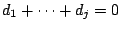
If the sum ![$x[n]$](img82.png) is to contain
line segments (not segments of curves), the
is to contain
line segments (not segments of curves), the  terms
in the sum must sum to zero. From the expansion of
above, this implies that
terms
in the sum must sum to zero. From the expansion of
above, this implies that
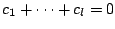 . Analyses of
complex waveforms (as in the figure) will always satisfy this
condition because the changes in slope, over a cycle, must all add
to zero for the waveform to connect with itself.
. Analyses of
complex waveforms (as in the figure) will always satisfy this
condition because the changes in slope, over a cycle, must all add
to zero for the waveform to connect with itself.