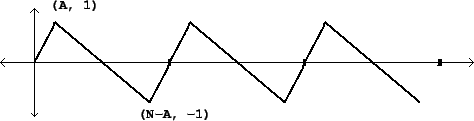
A general, non-symmetric triangle wave appears
in Figure 10.7. Here we have arranged the
cycle so that, first, the DC component is zero (so that the two
corners have equal and opposite heights), and second, so that the
midpoint of the shorter segment goes through the point  .
.
The two line segments have slopes equal to
 and
and  , so the
decomposition into component parabolic waves is given
by:
, so the
decomposition into component parabolic waves is given
by:
![\begin{displaymath} x[n] = {{N^2} \over {AN - 2{A^2}}} (p[n+A] - p[n-A]) \end{displaymath}](img1390.png)
![$p[n]$](img1391.png) to replace
to replace ![$p[n-(N-A)]$](img1392.png) by
by ![$p[n+A]$](img1393.png) ).)
).)
The most general way of dealing with linear
combinations of elementary (parabolic and/or sawtooth) waves is to
go back to the Fourier components, as we did in finding the series
for the elementary waves themselves. But in this particular case we
can use a trigonometric identity to avoid the extra work of
converting back and forth. Just plug in the trigonometric
series:
![\begin{displaymath} x[n] = {{N^2} \over {2{\pi ^ 2} (AN - 2{A^2})}} \left [ {\cos ( \omega (n-A))} - {\cos ( \omega (n+A))} \right . \end{displaymath}](img1394.png)
![\begin{displaymath} \left [ + {{\cos ( 2 \omega (n-A)) - \cos ( 2 \omega (n+A))} \over 4} + \cdots \right ] \end{displaymath}](img1395.png)


 .) This is a simplification
since the first sine term does not depend on
.) This is a simplification
since the first sine term does not depend on  ,
and hence is just an amplitude term. Applying the identity to all
the terms of the expansion for
,
and hence is just an amplitude term. Applying the identity to all
the terms of the expansion for ![$x[n]$](img82.png) gives:
gives:![\begin{displaymath} x[n] = a[1] \sin(\omega n) + a[2] \sin(2 \omega n) + \cdots \end{displaymath}](img1398.png)
![\begin{displaymath} a[k] = {1 \over {{\pi ^ 2} (A/N - 2{{(A/N)}^2})}} {{\sin (2 \pi k A / N) } \over {k^2}} \end{displaymath}](img1399.png)
 and
and  , but only on
their ratio,
, but only on
their ratio,  (this is not surprising because the
shape of the waveform depends on this ratio). If we look at small
values of
(this is not surprising because the
shape of the waveform depends on this ratio). If we look at small
values of  :
:
 and using the approximation
 we find that
![$a[k]$](img1403.png) drops off as
drops off as  , just
as the partials of a sawtooth wave. But for larger values of
the sine term oscillates between 1 and -1,
so that the amplitudes drop off irregularly as
, just
as the partials of a sawtooth wave. But for larger values of
the sine term oscillates between 1 and -1,
so that the amplitudes drop off irregularly as  .
.
Figure 10.8
shows the partial strengths with set to 0.03;
here, our prediction is that the dependence should
extend to
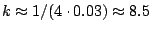 , in
rough agreement with the figure.
, in
rough agreement with the figure.
Another way to see why the partials should
behave as for low values of
and thereafter, is to compare the period
of a given partial with the length of the short segment,
 . For partials numbering less than
 , the period is at least twice the
length of the short segment, and at that scale the waveform is
nearly indistinguishable from a sawtooth wave. For partials
numbering in excess of
, the period is at least twice the
length of the short segment, and at that scale the waveform is
nearly indistinguishable from a sawtooth wave. For partials
numbering in excess of  , the two corners of the
triangle wave are at least one period apart, and at these higher
frequencies the two corners (each with
frequency dependence) are resolved from each other. In the figure,
the notch at partial 17 occurs at the wavelength
, the two corners of the
triangle wave are at least one period apart, and at these higher
frequencies the two corners (each with
frequency dependence) are resolved from each other. In the figure,
the notch at partial 17 occurs at the wavelength
 , at which wavelength the
two corners are one cycle apart; since the corners are opposite in
sign they cancel each other.
, at which wavelength the
two corners are one cycle apart; since the corners are opposite in
sign they cancel each other.
 and
and  .
.