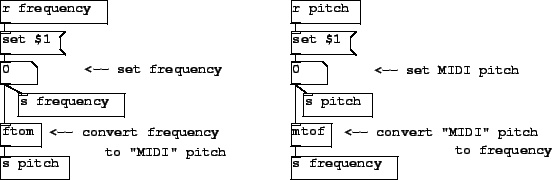
Patch A06.frequency.pd (figure 1.9) shows Pd's object for converting pitch to
frequency units (mtof, meaning "MIDI to frequency")
and its inverse ftom. We also introduce two other
object classes, send and
receive:
 ,
,
 : Converts MIDI pitch to
frequency units according to the PITCH/FREQUENCY CONVERSION
formulas. Inputs and outputs are messages (but "tilde" equivalents
of the two also exist, although like
: Converts MIDI pitch to
frequency units according to the PITCH/FREQUENCY CONVERSION
formulas. Inputs and outputs are messages (but "tilde" equivalents
of the two also exist, although like dbtorms~ they're
expensive in CPU time). The ftom object's output is
-1500 of the input is zero or negative; and likewise, if you give
mtof -1500 or lower it outputs zero.
 ,
,
 : Receive messages
non-locally. The
: Receive messages
non-locally. The receive object, which may be
abbreviated as ``r" waits for non-local messages to be
sent by a send object (below) or by a message box
using redirection (the ``;" feature discussed in the earlier
example, A01.sinewave.pd). The argument (such as ``frequency" and
``pitch" in this example) is the name to which messages are sent.
Multiple receive objects may share the same name, in
which case any message sent to that name will go to all of
them.
 ,
,
 : The
: The send
object, which may be abbreviated as ``s", directs
messages to receive objects.
Two new properties of number boxes are used here. Heretofore we've used them as controls or as displays; here, the two number boxes each function as both. If a number box gets a number in its inlet, it not only displays the number but also repeats it to its output. However, a number box may also be sent a ``set" message, such as ``set 55" for example. This would set the value of the number box to 55 (and display it) but not cause the output that would result from the simple ``55" message. In this case, numbers coming from the two receives are formatted (using message boxes) to read ``set 55" instead of just ``55", and so on. (The special word ``$1" is replaced by the incoming number.) This is done because otherwise we would have an infinite loop: frequency would change pitch which would change frequency and so on forever, or at least until something breaks.