Figure 2.2
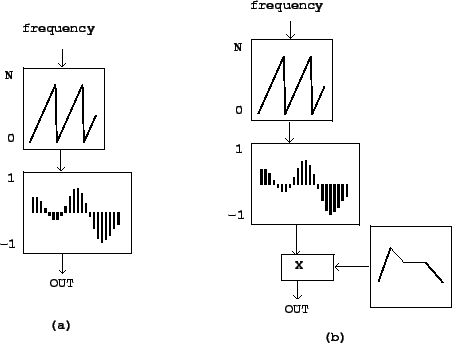
suggests an easy way to synthesize any desired fixed waveform at
any desired frequency, using the block diagram shown in Figure
2.3. The upper block is an oscillator--not
the sinusoidal oscillator we saw earlier, but one which produces
sawtooth waves instead. The output values, as indicated at the left
of the block, should range from  to the wavetable
size
to the wavetable
size  . This is used as an index into the wavetable
lookup block (introduced in Figure 2.1), resulting, as shown in Figure
2.2(b,c), in a periodic
waveform. Figure 2.3(b) adds an envelope
generator and a multiplier to control the output amplitude in the
same way as for the sinusoidal oscillator shown in Chapter 1.
Often, one uses a wavetable with (RMS or peak) amplitude 1, so that
the amplitude of the output is just the magnitude of the envelope
generator's output.
. This is used as an index into the wavetable
lookup block (introduced in Figure 2.1), resulting, as shown in Figure
2.2(b,c), in a periodic
waveform. Figure 2.3(b) adds an envelope
generator and a multiplier to control the output amplitude in the
same way as for the sinusoidal oscillator shown in Chapter 1.
Often, one uses a wavetable with (RMS or peak) amplitude 1, so that
the amplitude of the output is just the magnitude of the envelope
generator's output.
 |
Wavetable oscillators are often used to
synthesize sounds with specified, static spectra. To do this, you
can precompute samples of any waveform of period
(angular frequency  ) by
adding up the elements of the FOURIER SERIES (section 1.8). The computation involved in
setting up the wavetable at first might be significant, but this
may be done in advance of the synthesis process, which can then
take place in real time. Frequently, wavetables are prepared in
advance and stored in files to be loaded into memory as needed for
performance.
) by
adding up the elements of the FOURIER SERIES (section 1.8). The computation involved in
setting up the wavetable at first might be significant, but this
may be done in advance of the synthesis process, which can then
take place in real time. Frequently, wavetables are prepared in
advance and stored in files to be loaded into memory as needed for
performance.
While direct additive synthesis of complex
waveforms, as shown in Chapter 1, is in principle infinitely
flexible as a technique for producing time-varying timbres,
wavetable synthesis is much less expensive in terms of computation
but requires switching wavetables to change the timbre. An
intermediate technique, more flexible and expensive than simple
wavetable synthesis but less flexible and less expensive than
additive synthesis, is to create time-varying mixtures between a
small number of fixed wavetables. If the number of wavetables is
only two, this is in effect a cross-fade between the two waveforms,
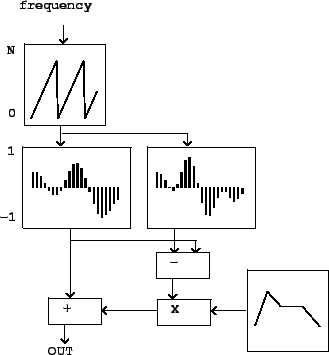
as diagrammed in figure 2.3. Here we
suppose that some signal
![$0 \le x[n] \le 1$](img196.png) is to control the relative
strengths of the two waveforms, so that, if
is to control the relative
strengths of the two waveforms, so that, if ![$x[n] = 0$](img197.png) ,
we get the first one and if
,
we get the first one and if ![$x[n] = 1$](img198.png) we get the
second. Supposing the two signals to be cross-faded are
we get the
second. Supposing the two signals to be cross-faded are ![$y[n]$](img1.png) and
and ![$z[n]$](img178.png) , we compute the
signal
, we compute the
signal
![\begin{displaymath} (1 - x[n])y[n] + x[n]z[n], \end{displaymath}](img199.png)
![\begin{displaymath} y[n] + x[n](z[n]-y[n]). \end{displaymath}](img200.png)
In using this technique to cross-fade between wavetable oscillators, it might be desirable to keep the phases of corresponding partials the same across the wavetables, so that their amplitudes combine additively when they are mixed. On the other hand, if arbitrary wavetables are used (for instance, borrowed from a recorded sound) there will be a phasing effect as the different waveforms are mixed.
This scheme can be extended in a daisy chain to travel a continuous path between a succession of timbers. Alternatively, or in combination with daisy-chaining, cross-fading may be used to interpolate between two different timbres, for example as a function of musical dynamic. To do this you would prepare two or even several waveforms of a single synthetic voice played at different dynamics. and interpolate between successive ones as a function of the output dynamic you want.
You can even use pre-recorded instrumental (or other) sounds as a waveform. In its simplest form this is called "sampling" and is the subject of the next section.