


We have heretofore discussed digital audio
signals as if they were capable of describing any function of time,
in the sense that knowing the values the function takes on the
integers should somehow determine the values it takes between them.
This isn't really true. For instance, suppose some function
 (defined for real numbers) happens to
attain the value 1 at all integers:
(defined for real numbers) happens to
attain the value 1 at all integers:  for
for
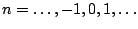 . We might guess
that
. We might guess
that  for all real
  . But
perhaps happens to be one for integers and zero
everywhere else--that's a perfectly good function too, and nothing
about the function's values at the integers distinguishes it from
the simpler . But intuition tells us that the
constant function is in the spirit of digital audio signals,
whereas the one that hides a secret between the samples isn't. A
function that is ``possible to sample" should be one for which we
can use some reasonable interpolation scheme to deduce its values
for non-integers from its values for integers.
. But
perhaps happens to be one for integers and zero
everywhere else--that's a perfectly good function too, and nothing
about the function's values at the integers distinguishes it from
the simpler . But intuition tells us that the
constant function is in the spirit of digital audio signals,
whereas the one that hides a secret between the samples isn't. A
function that is ``possible to sample" should be one for which we
can use some reasonable interpolation scheme to deduce its values
for non-integers from its values for integers.
It is customary at this point in discussions of
computer music to invoke the famous Nyquist theorem. This states (roughly speaking)
that if a function is a finite or even infinite combination of REAL
SINUSOIDS, none of whose angular frequencies exceeds  , then, theoretically at least, it is fully determined by
the function's values on the integers. One possible way of
reconstructing the function would be as a limit of higher- and
higher-order polynomial interpolation.
, then, theoretically at least, it is fully determined by
the function's values on the integers. One possible way of
reconstructing the function would be as a limit of higher- and
higher-order polynomial interpolation.
The angular frequency ,
called the Nyquist frequency, corresponds to  cycles per second if
  is the sample rate. The
corresponding period is two samples. The Nyquist frequency is the
best we can do in the sense that any real sinusoid of higher
frequency is equal, at the integers, to one whose frequency is
lower than the Nyquist, and it is this lower frequency that will
get reconstructed by the ideal interpolation process. For instance,
a REAL SINUSOID with angular frequency between
and
is the sample rate. The
corresponding period is two samples. The Nyquist frequency is the
best we can do in the sense that any real sinusoid of higher
frequency is equal, at the integers, to one whose frequency is
lower than the Nyquist, and it is this lower frequency that will
get reconstructed by the ideal interpolation process. For instance,
a REAL SINUSOID with angular frequency between
and  , say
, say  , can be
written as
, can be
written as

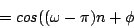

 . (If
weren't an integer the first step would fail.) So a sinusoid with
frequency between and was equal, on the integers at least, to one with
frequency between 0 and ; you simply can't tell the
two apart. And since any conversion hardware will do the ``right"
thing and reconstruct the lower-frequency sinusoid, any
higher-frequency one you try to synthesize will come out your
speakers at the wrong frequency--specifically, you will hear the
unique frequency between 0 and that the higher
frequency lands on when reduced in the above way. This phenomenon
is called foldover, because
the half-line of frequencies from 0 to
. (If
weren't an integer the first step would fail.) So a sinusoid with
frequency between and was equal, on the integers at least, to one with
frequency between 0 and ; you simply can't tell the
two apart. And since any conversion hardware will do the ``right"
thing and reconstruct the lower-frequency sinusoid, any
higher-frequency one you try to synthesize will come out your
speakers at the wrong frequency--specifically, you will hear the
unique frequency between 0 and that the higher
frequency lands on when reduced in the above way. This phenomenon
is called foldover, because
the half-line of frequencies from 0 to  is folded
back and forth, in lengths of , onto the
interval from 0 to . The word aliasing
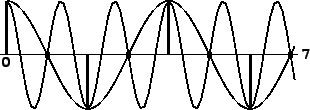
means the same thing. Figure 3.1 shows sinusoids of angular frequencies
is folded
back and forth, in lengths of , onto the
interval from 0 to . The word aliasing
means the same thing. Figure 3.1 shows sinusoids of angular frequencies
 and
and  ; the higher
frequency folds over to the lower one.
; the higher
frequency folds over to the lower one.
 |
We conclude that when, for instance, we're
computing an EXPLICIT SUM OF SINUSOIDS, either as a wavetable or as
a real-time signal, we had better drop any sinusoid in the sum
whose frequency exceeds . But the picture in
general is not this simple, since most techniques other than
additive synthesis don't lead to neat, band-limited signals (ones
whose components stop at some limited frequency.) For example, a
sawtooth wave of frequency  , of the form
put out by Pd's
, of the form
put out by Pd's
 object but considered as
a continuous function
object but considered as
a continuous function  , expands
to:
, expands
to:
 , the
partials above will be audibly present--and,
because of foldover, they will be heard at incorrect frequencies.
(This does not mean that one shouldn't use sawtooth waves as phase
generators--the wavetable lookup step magically fixes the foldover
problem--but one should think twice before using a sawtooth wave
itself as a digital sound source.)
, the
partials above will be audibly present--and,
because of foldover, they will be heard at incorrect frequencies.
(This does not mean that one shouldn't use sawtooth waves as phase
generators--the wavetable lookup step magically fixes the foldover
problem--but one should think twice before using a sawtooth wave
itself as a digital sound source.)
Many synthesis techniques, even if not strictly
band-limited, give partials which may be made to drop off more
rapidly than  as in the sawtooth example, and are
thus more forgiving to work with digitally. In any case, it is
always a good idea to keep the possibility of foldover in mind, and
to train your ears to recognize it.
as in the sawtooth example, and are
thus more forgiving to work with digitally. In any case, it is
always a good idea to keep the possibility of foldover in mind, and
to train your ears to recognize it.
The first line of defense against foldover is simply to use high sample rates; it is a good practice to systematically use the highest sample rate that your computer can easily handle. The highest practical rate will vary according to whether you are working in real time or not, CPU time and memory constraints, and/or input and output hardware, and sometimes even software-imposed limitations.
A very non-technical treatment of sampling theory is given in [Bal03]. More detail can be found in [Mat69, pp. 1-30].