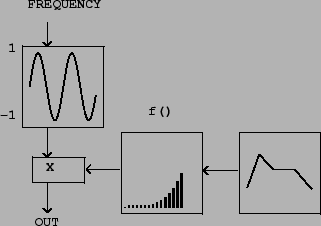
Suppose you wish to fade a signal in over a
period of ten seconds--that is, you wish to multiply it by an
amplitude-controlling signal ![$y[n]$](img1.png) which rises from 0
to 1 in value over
which rises from 0
to 1 in value over  samples, where
  is the sample rate. The most obvious choice would be a
linear ramp:
is the sample rate. The most obvious choice would be a
linear ramp:
![$y[n] = n/(10R)$](img395.png) . But this will not turn out to
yield a smooth increase in perceived loudness. Over the first
second rises from
. But this will not turn out to
yield a smooth increase in perceived loudness. Over the first
second rises from  dB to
-20 dB, over the next four by another 14 dB, and over the remaining
five, only by the remaining 6 dB. Over most of the ten second
period the rise in amplitude will be barely perceptible.
dB to
-20 dB, over the next four by another 14 dB, and over the remaining
five, only by the remaining 6 dB. Over most of the ten second
period the rise in amplitude will be barely perceptible.
Another possibility would be to ramp exponentially, so that it rises at a constant rate in dB.
You would have to fix the initial amplitude to be inaudible, say 0
dB (if we fix unity at 100 dB). Now we have the opposite problem:
for the first five seconds the amplitude control will rise from 0
dB (inaudible) to 50 dB (pianissimo); this amount of rise should
have only taken up the first second or so.
The natural progression should perhaps have been: 0-ppp-pp-p-mp-mf-f-ff-fff, so that each increase of one dynamic marking would take roughly one second, and would correspond to one "step" in loudness.
We appear to need some scale in between
logarithmic and linear. A somewhat arbitrary choice, but useful in
practice, is the quartic curve:
![\begin{displaymath} y[n] = {{ \left ( {{n} \over {N}} \right ) } ^ 4} , \end{displaymath}](img396.png)
 is the number of samples to
fade in over (in the example above, it's ). So,
over the second (of the ten) we would rise to -80 dB, after five
seconds to -24 dB, and after nine, about -4 dB.
is the number of samples to
fade in over (in the example above, it's ). So,
over the second (of the ten) we would rise to -80 dB, after five
seconds to -24 dB, and after nine, about -4 dB.
Figure 4.3 shows three
amplitude transfer functions:



 .)
.)
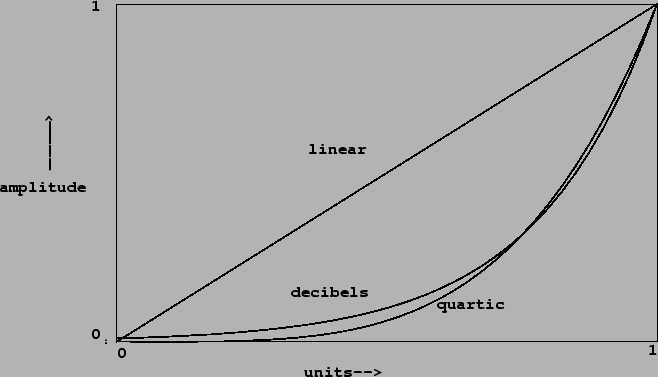 |
We can think of the three curves as showing
transfer functions, from an abstract control (ranging from 0 to 1)
to a linear amplitude. After we choose a suitable transfer function
 , we can compute a corresponding amplitude
control signal; if we wish to ramp over samples from
silence to unity gain, the control signal would be:
, we can compute a corresponding amplitude
control signal; if we wish to ramp over samples from
silence to unity gain, the control signal would be:
![\begin{displaymath} y[n] = f(n/N) . \end{displaymath}](img402.png)