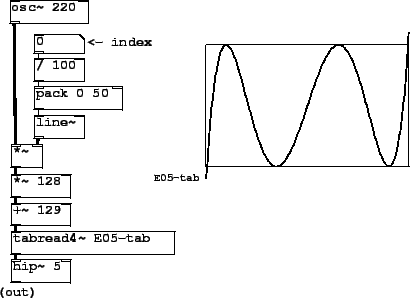
Patch E05.chebychev.pd(Figure 5.12) demonstrates how you can use waveshaping to generate pure harmonics. We'll limit ourselves to a specific example here; for more details see [Leb79]. In this example we would like to generate the pure fifth harmonic,

![\begin{displaymath} x[n] = \cos (\omega n) \end{displaymath}](img498.png)
 . Our technique is to use the formula for
the waveshaping function
. Our technique is to use the formula for
the waveshaping function  (page
(page ![[*]](file:/usr/local/share/lib/latex2html/icons/crossref.png) ),
which gives first, third and fifth harmonics:
),
which gives first, third and fifth harmonics:
 to cancel the third harmonic:
 to cancel the
first harmonic:
to cancel the
first harmonic:

 are known as
Chebychev polynomials.
are known as
Chebychev polynomials.
To incorporate this in a waveshaping instrument,
we simply build a patch that works as in Figure 5.5, computing the
expression
![\begin{displaymath} x[n] = f( a[n] \cos(\omega n)) \end{displaymath}](img549.png)
![$a[n]$](img550.png) is a suitable index which may vary as a function of
the sample number
is a suitable index which may vary as a function of
the sample number  . When
  happens to
be one in value, out comes the pure fifth harmonic. Other values of
give varying spectra which, in general, have
first and third harmonics as well as the fifth.
happens to
be one in value, out comes the pure fifth harmonic. Other values of
give varying spectra which, in general, have
first and third harmonics as well as the fifth.
By suitably combining Chebychev polynomials we can fix any desired superposition of components in the output waveform (again, as long as the waveshaping index is one). But the real promise of waveshaping--that by simply changing the index we can manufacture spectra that evolve in a variety of interesting ways--is not addressed, at least directly, in the Chebychev picture.