


Next: How to find and Up: About the Software Examples
Previous: About the Software Examples Contents
Index
Pd documents are called ``patches." They correspond roughly to
the boxes in the abstract block diagrams shown earlier in this
chapter, but in detail they are quite different, reflecting the
fact that Pd is an implementation environment and not a
specification language.
A Pd patch, such as the one shown in Figure 1.9, consists of a collection of boxes connected in a network called a patch. The border of a box tells you
how its text is interpreted and how the box functions. In part (a)
of the figure we see three types of boxes. From top to bottom they
are:
- a message box. Message boxes, with a flag-shaped
border, interpret the text as a message to send whenever the box is
activated (by an incoming message or with the mouse.) The message
in this case consists simply of the number ``34".
- an object box. Object boxes have a rectangular
border; they use the text to create objects when you load a patch.
Object boxes may represent hundreds of different classes of
objects--including oscillators, envelope generators, and other
signal processing modules to be introduced later--depending on the
text inside. In this example, the box contains an adder. In most Pd
patches, the majority of boxes are of type ``object". The first
word typed into an object box specifies its class, which in this case is just ``+". Any
additional (blank-space-separated) words appearing in the box are
called creation arguments, which specify the initial
state of the object when it is created.
- a number box. number boxes are a particular case of
a GUI
box, which also include push buttons, toggle switches, sliders,
and more; these will come up later in the examples. The number box
has a punched-card-shaped border, with a nick out of its top right
corner. Whereas the appearance of an object or message box is
static when a patch is running, a number box's contents (the text)
changes to reflect the current value held by the box. You can also
use a number box as a control by clicking and dragging up and down,
or by typing values in it.
In fig. 1.9(a) the message box, when
clicked, sends the message ``21" to an object box which adds 13 to
it. The lines connecting the boxes carry data from one box to the
next; outputs of boxes are on the bottom and inputs on top.
Figure 1.9: (a) three
types of boxes in Pd (message, object, and GUI); (b) a simple patch
to output a Sinusoid.
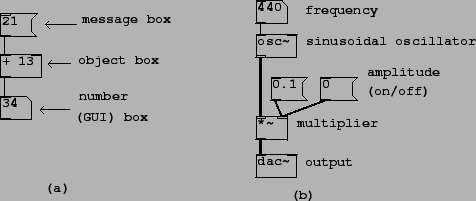 |
Figure 1.9(b) shows a Pd patch which
makes a Sinusoid with controllable frequency and amplitude. The
connecting patch lines are of two types here; the thin ones are for
carrying sporadic messages, and
the thicker ones (connecting the oscillator, the multiplier, and
the output ``dac ") carry digital audio signals. Since Pd is a
real-time program, the audio signals flow in a continuous stream.
On the other hand, the sporadic messages appear at specific but
possibly unpredictable instants in time.
Whether a connection carries messages or signals is a function
of the box the connection comes from; so, for instance, ``+"
outputs messages, but ``*~" outputs a signal. The inputs of objects
may or may not accept signals (but they always accept messages,
even if only to convert them to signals). As a naming convention,
object boxes which input or output signals are all named with a
trailing tilde (``~") as in ``*~" and ``osc~".
Next: How to find and Up: About the Software Examples
Previous: About the Software Examples Contents
Index
Miller Puckette 2006-03-03