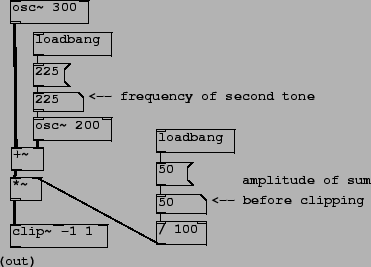
Patch E04.difference.tone.pd(Figure 5.11) introduces waveshaping, demonstrating the nonlinearity of the process. Two sinusoids (300 and 225 Hz, or a ratio of 4 to 3) are summed and then clipped, using a new object class:
 : signal clipper. When the signal lies between the limits
specified by the arguments to the clip~ object, it is
passed through unchanged; but when it falls below the lower limit
or rises above the upper limit, it is replaced by the lower or
upper limit, respectively. The effect of clipping a sinusoidal
signal was shown graphically in Figure 5.6.
: signal clipper. When the signal lies between the limits
specified by the arguments to the clip~ object, it is
passed through unchanged; but when it falls below the lower limit
or rises above the upper limit, it is replaced by the lower or
upper limit, respectively. The effect of clipping a sinusoidal
signal was shown graphically in Figure 5.6.
As long as the amplitude of the sum of sinusoids is less than 50
percent, the sum can't exceed one in absolute value and the
clip~ object passes the pair of sinusoids through
unchanged to the output. As soon as the amplitude exceeds 50
percent, however, the nonlinearity of the clip~ object
brings forth distortion products (at frequencies  for integers
  and
and  ),
all of which happening to be multiples of 75, give rise to a tone
whose fundamental is 75. Seen another way, the shortest common
period of the two sinudusoids is 1/75 second (which is four periods
of the 300 Hx, tone and three periods of the 225 Hz, tone), so the
result has period 1/75 second.
),
all of which happening to be multiples of 75, give rise to a tone
whose fundamental is 75. Seen another way, the shortest common
period of the two sinudusoids is 1/75 second (which is four periods
of the 300 Hx, tone and three periods of the 225 Hz, tone), so the
result has period 1/75 second.
The 225 Hz. tone in the patch may be varied. If it is moved slightly away from 225, a beating sound results. Other values may find other common subharmonics, and still others may give rise to rich, inharmonic tones.