


The same techniques will work to analyze any delay network, although for more complicated networks it becomes harder to characterize the results, or to design the network to have specific, desired properties. Another point of view can sometimes be usefully brought to the situation, particularly when flat frequency responses are needed, either in their own right or else to ensure that a complex, recirculating network remains stable at feedback gains close to one.
The central fact we will use is that if any delay network, with either one or many inputs and outputs, is constructed so that its output power (averaged over time) always equals its input power, that network has to have a flat frequency response. This is almost a tautology; if you put in a sinusoid at any frequency on one of the inputs, you will get sinusoids of the same frequency at the outputs, and the sum of the power on all the outputs will equal the power of the input, so the gain, suitably defined, is exactly one.
In order to work with power-conserving delay networks we will
need an explicit definition of ``total average power". If there is
only one signal (call it ![$x[n]$](img79.png) ), the average power is
given by:
), the average power is
given by:
![\begin{displaymath} P(x[n]) = \left [{{\vert x[0]\vert}^2} + {{\vert x[1]\vert}^2} + \cdots + {{\vert x[N-1]\vert}^2} \right ] / N \end{displaymath}](img735.png)
 is a large enough number so that any
fluctuations in amplitude get averaged out. This definition works
as well for complex-valued signals as for real-valued ones. The
average total power for several digital audio signals is just the
sum of the individual signal's powers:
is a large enough number so that any
fluctuations in amplitude get averaged out. This definition works
as well for complex-valued signals as for real-valued ones. The
average total power for several digital audio signals is just the
sum of the individual signal's powers:![\begin{displaymath} P({x_1}[n] , \ldots , {x_r}[n]) = P({x_1}[n]) + \cdots + P({x_r}[n]) \end{displaymath}](img736.png)
 is the number of signals to be combined.
With this definition, since the individual signals' power is
perserved by delaying them, so is the power of the sum.
is the number of signals to be combined.
With this definition, since the individual signals' power is
perserved by delaying them, so is the power of the sum.
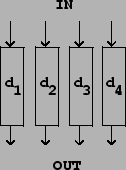
It turns out that a wide range of interesting delay networks has the property that the total power output equals the total power input; they are called unitary. To start with, we can put any number of delays in parallel, as shown in Figure 7.11. Whatever the total power of the inputs, the total power of the outputs has to equal it.
A second family of power-preserving transformations is composed
of rotations and reflections of the signals ![${x_1}[n]$](img737.png) ,
... ,
,
... , ![${x_r}[n]$](img738.png) , considering them, at each fixed
time point
, considering them, at each fixed
time point  , as numbers, or as a
point in an -dimensional space. The rotation or
reflection must be one that leaves the origin
, as numbers, or as a
point in an -dimensional space. The rotation or
reflection must be one that leaves the origin
 fixed.
For each sample number , the total
contribution to the average signal power is proportional to
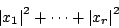
 . Since rotations and
reflections are distance-preserving transformations, the distance
from the origin before transforming must equal the distance from
the origin afterward. So the total power of a collection of signals
must must be preserved by rotation.
. Since rotations and
reflections are distance-preserving transformations, the distance
from the origin before transforming must equal the distance from
the origin afterward. So the total power of a collection of signals
must must be preserved by rotation.
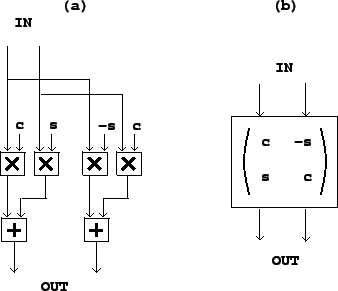 |
Figure 7.12 shows a rotation matrix
operating on two signals. In part (a) the transformation is shown
explicitly. If the input signals are and
![${x_2}[n]$](img743.png) , the outputs are:
, the outputs are:
![\begin{displaymath} {y_1}[n] = c {x_1}[n] - s {x_2}[n] \end{displaymath}](img744.png)
![\begin{displaymath} {y_2}[n] = s {x_1}[n] + c {x_2}[n] \end{displaymath}](img745.png)
 are given by

 . Considered as points on the Cartesian
plane, the point
. Considered as points on the Cartesian
plane, the point
 is just the point
 rotated counter-clockwise by
the angle . The two points are thus at the
same distance from the origin:
rotated counter-clockwise by
the angle . The two points are thus at the
same distance from the origin:
For an alternative description of rotation in two dimensions,
consider complex numbers
 and
and
 . The above transformation
amounts to setting
. The above transformation
amounts to setting

 is a complex number with unit magnitude and
argument . Since
is a complex number with unit magnitude and
argument . Since  ,
it follows that
,
it follows that  .
.
If we perform a rotation on a pair of signals and then invert
one (but not the other) of them, the result is a reflection. This also preserves total signal
power, since we can invert any or all of a collection of signals
without changing the total power. In two dimensions, a reflection
appears as a transformation of the form
![\begin{displaymath} {y_1}[n] = c {x_1}[n] + s {x_2}[n] \end{displaymath}](img756.png)
![\begin{displaymath} {y_2}[n] = s {x_1}[n] - c {x_2}[n] \end{displaymath}](img757.png)
Special and useful rotation and reflection matrices are obtained
by setting
 , so that
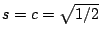 . This allows us to
simplify the computation as shown in Figure 7.13 (part a) because each signal need only be
multiplied by the one quantity
. This allows us to
simplify the computation as shown in Figure 7.13 (part a) because each signal need only be
multiplied by the one quantity  .
.
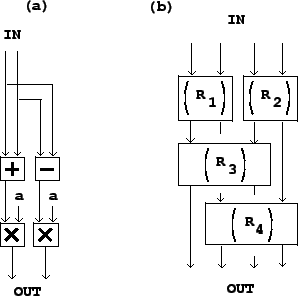 |
Any rotation or reflection of more than two input signals may be
accomplished by repeatedly rotating and/or reflecting them in
pairs. For example, in part (b) of Figure 7.13, four signals are combined in pairs, in two
succesive stages, so that in the end every signal input feeds into
all the outputs. We could do the same with eight signals (using
three stages) and so on. Furthermore, if we use the special angle
 , all the input signals will contribute
equally to each of the outputs.
, all the input signals will contribute
equally to each of the outputs.
Any combination of delays and rotation matrices, applied in succession to a collection of audio signals, will result in a flat frequency response, since each individual operation does. This already allows us to generate an infinitude of flat-response delay networks, but so far, none of them are recirculating. A third operation, shown in Figure 7.14, allows us to make recirculating networks that still enjoy flat frequency responses.
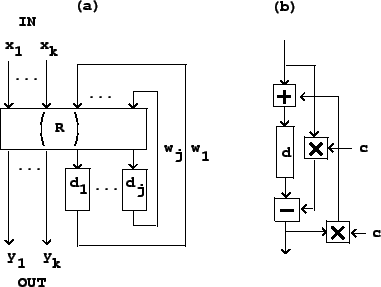 |
Part (a) of the figure shows the general layout. The
transformation  is assumed to be any combination of
delays and mixing matrices that are power preserving in the
aggregate. The signals
is assumed to be any combination of
delays and mixing matrices that are power preserving in the
aggregate. The signals
 go into a unitary delay
network, and the output signals
go into a unitary delay
network, and the output signals
 emerge. Some other
signals
emerge. Some other
signals
 (where
  is not necessarily equal to
  ) appear at the
output of the transformation and are fed back to
its input.
) appear at the
output of the transformation and are fed back to
its input.
If is indeed power preserving, the total input
power (the power of the signals
plus that of the signals
) must equal the output
power (the power of the signals
plus
), and subtracting all the
 from the equality, we find that the total
input and output power are equal.
from the equality, we find that the total
input and output power are equal.
If we let  so that there is one
  ,
,  , and , and let the
transformation be a rotation by followed by a delay of
, and , and let the
transformation be a rotation by followed by a delay of  samples on the
 output, the result is the well-known
all-pass filter. With some juggling, and letting
output, the result is the well-known
all-pass filter. With some juggling, and letting
 , we can show it is
equivalent to the network shown in part (b) of the figure. All-pass
filters have many applications, some of which we will visit later
in this book.
, we can show it is
equivalent to the network shown in part (b) of the figure. All-pass
filters have many applications, some of which we will visit later
in this book.
 , so that
 ;
(b) combining two-dimensional rotations to make higher-dimensional
ones.
;
(b) combining two-dimensional rotations to make higher-dimensional
ones.