


In example G06.octave.doubler.pd (Figure 7.29) we revisit the idea of pitch-based octave shifting introduced earlier in E03.octave.divider.pd. There, knowing the periodicity of an incoming sound allowed us to tune a ring modulator to introduce subharmonics. Here we realize the octave doubler described in Section 7.3. Using a variable, non-recirculating comb filter we filter out odd harmonics, leaving only the even ones, which sound an octave higher. As before, the spectral envelope of the sound is roughly preserved by the operation, so we can avoid the ``chipmunk" effect we would have got by using speed change to do the transposition.
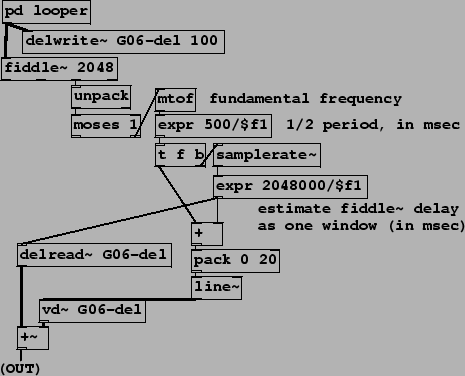 |
The comb filtering is done by combining two delayed copies of
the incoming signal (from the pd looper subpatch at top).
The fixed one (delread~) is set to a delay of 1/2 the
window size of the pitch following algorithm. Whereas in the
earlier example this was hidden in another subpatch, we can now
show this explicitly. The delay in milliseconds is estimated as
equal to the 2048-sample analysis window used by the
fiddle~ object; in milliseconds this comes to
 where
where  is the
sample rate.
is the
sample rate.
The variable delay is the same, plus 1/2 of the measured period
of the incoming sound, or  milliseconds where
  is the frequency in cycles
per second. The sum of this and the fixed delay time is then
smoothed using a line~ object to make the input signal for
the variable delay line.
is the frequency in cycles
per second. The sum of this and the fixed delay time is then
smoothed using a line~ object to make the input signal for
the variable delay line.
Since the difference between the two delays is  , the resonant frequencies of the resulting comb filter
are
, the resonant frequencies of the resulting comb filter
are
 ; the frequency response
(section 7.3) is zero at
the frequencies
; the frequency response
(section 7.3) is zero at
the frequencies  , so the resulting sound
contains only the partials at multiples of
, so the resulting sound
contains only the partials at multiples of  --an
octave above the original. Seen another way, the incoming sound is
output twice, a half-cycle apart; odd harmonics are thereby shifted
180 degrees (
--an
octave above the original. Seen another way, the incoming sound is
output twice, a half-cycle apart; odd harmonics are thereby shifted
180 degrees ( radians) and cancel; even harmonics
are in phase with their delayed copies and remain in the sum.
radians) and cancel; even harmonics
are in phase with their delayed copies and remain in the sum.
Both this and the octave divider may be altered to make shifts of 3 or 4 to one in frequency, and they may also be combined to make compound shifts such as a music fifth (a ratio of 3:2) by shifting down an octave and then back up a factor of three. (You should do the down-shifting before the up-shifting for best results.)