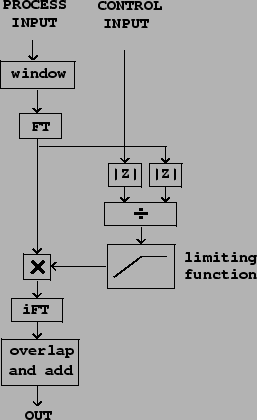
A second application of Fourier analysis and resynthesis is a time-varying filter capable of making one sound take on the evolving spectral envelope of another. This is widely known in electronic music circles as a vocoder, named, not quite accurately, after the original Bell Laboratories vocal analysis/synthesis device of that name. The technique described here is more accurately called timbre stamping. Two input signals are used, one to be filtered, and the other to control the filter via its time-varying spectral envelope. The windowed Fourier transform is used both on the control signal input to estimate its spectral envelope, and on the filter input in order to apply the filter.
A block diagram for timbre stamping is shown in Figure 9.9. As in the previous example, the timbre stamp
acts by multiplying the complex-valued windowed Fourier transform
of the filtering input by non-negative real numbers, hence scaling
their amplitudes but leaving their phases intact. Here the twist is
that we want simply to replace the magnitudes of the original,
![$\vert S[m, k]\vert$](img1171.png) , with magnitudes obtained
from the control input (call them
, with magnitudes obtained
from the control input (call them ![$\vert T[m, k]\vert$](img1172.png) , say). The necessary gain would thus
be,
, say). The necessary gain would thus
be,
![\begin{displaymath} g[m, k] = {{\vert T[m, k]\vert}\over{\vert S[m, k]\vert}} \end{displaymath}](img1173.png)