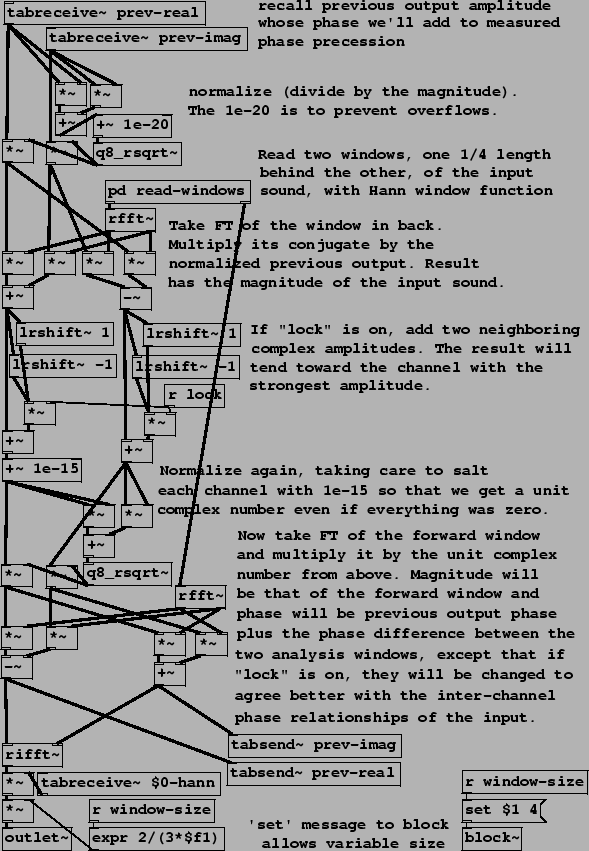
The phase vocoder usually refers to the general technique of passing from (complex-valued) channel amplitudes to pairs consisting of (real-valued) magnitudes and phase precession rates (``frequencies"), and back, as described in Figure 9.11 (Section 9.5). In Example I07.phase.vocoder.pd (Figure 9.18), we use this technique for the specific goal of time-stretching and/or time-contracting a recorded sound under real-time control. That is, we control, at any moment in real time, the location in the recorded sound we hear. One new object is used:
 : Shift a block left or right according to its argument.
If the argument is positive, each block of the output is the input
shifted that number of spaces to the right, filling zeros in as
needed on the left. A negative argument shifts to the left, filling
zeros in at the right.
: Shift a block left or right according to its argument.
If the argument is positive, each block of the output is the input
shifted that number of spaces to the right, filling zeros in as
needed on the left. A negative argument shifts to the left, filling
zeros in at the right.
The process starts with a sub-patch, pd read-windows, which outputs two Hann-windowed blocks of the recorded sound, a ``back" one and a ``front" one 1/4 window further forward in the recording. The window shown uses the two outputs of the sub-patch to guide the amplitude and phase change of each channel of its own output.
The top two tabreceive~ objects recall the previous
block of complex amplitudes sent to the rifft~ object at
bottom, corresponding to ![$S[m-1,k]$](img1196.png) in the discussion of
Section 9.5. The patch as a
whole computes
in the discussion of
Section 9.5. The patch as a
whole computes ![$S[m, k]$](img1164.png) and then its Hann windowed
inverse FT for output.
and then its Hann windowed
inverse FT for output.
After normalizing , its complex
conjugate (equal to its inverse) is multiplied by the windowed
Fourier transform of the ``back" window ![$T[k]$](img1197.png) , giving
the product
, giving
the product
![\begin{displaymath} R[k] \; = \; { {{S[m-1, k]} \over {T[k]} \; \cdot \; { \left \vert {S[m-1, k]} \right \vert} } } \end{displaymath}](img1203.png)
![$R[k]$](img1204.png) is conditionally replaced with the
phase-locking version
is conditionally replaced with the
phase-locking version ![$R'[k]$](img1241.png) . This is done using
lrshift~ objects, whose outputs are added into if ``lock" is set to one, or otherwise not if it is zero.
The result is then normalized and multiplied by the Hann-windowed
Fourier transform of the ``front" window (
. This is done using
lrshift~ objects, whose outputs are added into if ``lock" is set to one, or otherwise not if it is zero.
The result is then normalized and multiplied by the Hann-windowed
Fourier transform of the ``front" window (![$T'[k]$](img1194.png) ) to
give .
) to
give .
Three other applications of Fourier analysis/resynthesis, not pictured here, are provided in the Pd examples. First, Example I08.pvoc.reverb.pd shows how to make a phase vocoder whose output recirculates as in a reverberator, except that individual channels are replaced by the input when it is more powerful than what is already recirculating. The result is a more coherent-sounding reverberation effect than can be made in the classical way using delay lines.
Example I09.sheep.from.goats.pd demonstrates the (imperfect)
technique of separating pitched signals from noisy ones, channel by
channel, based on the phase coherence we should expect from a
Hann-windowed sinusoid. If three adjacent channels are
approximately  radians out of phase from each other,
they are judged to belong to a sinusoidal peak. Channels belonging
to sinusoidal peaks are replaced with zero to extract the noisy
portion of the signal, or all others are replaced with zero to give
the sinusoidal portion.
radians out of phase from each other,
they are judged to belong to a sinusoidal peak. Channels belonging
to sinusoidal peaks are replaced with zero to extract the noisy
portion of the signal, or all others are replaced with zero to give
the sinusoidal portion.
Example I10.phase.bash.pd returns to the wavetable looping
sampler of Figure 2.7, and shows
how to align the phases of the sample so that all components of the
signal have zero phase at points 0,  ,
,  , and so on. In this way, two copies of a looping sampler
placed samples apart can be coherently cross-faded.
A synthetic, pitched version of the original soundfile can be made
using daisy-chained cross-fades.
, and so on. In this way, two copies of a looping sampler
placed samples apart can be coherently cross-faded.
A synthetic, pitched version of the original soundfile can be made
using daisy-chained cross-fades.