


As a first line of defense against foldover, we can synthesize
the waveform at a much higher sample rate, apply a low-pass filter
whose cutoff frequency is set to the Nyquist frequency (for the
original sample rate), then down-sample. For example, in the above
scenario (44100 sample rate, 440 Hz. tone) we could generate the
sawtooth at a sample rate of
 Hz. We need only
worry about frequencies in excess of
Hz. We need only
worry about frequencies in excess of
 Hz. (so that they fold
over into audible frequencies; foldover to ultrasonic frequencies
normally won't concern us) so the first problematic partial is
Hz. (so that they fold
over into audible frequencies; foldover to ultrasonic frequencies
normally won't concern us) so the first problematic partial is
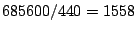 , whose amplitude is -64dB
relative to that of the fundamental.
, whose amplitude is -64dB
relative to that of the fundamental.
 |
This attenuation degrades by 6 dB for every octave the fundamental is raised, so that a 10 kHz. sawtooth only enjoys a 37 dB drop from the fundamental to the loudest foldover partial. On the other hand, raising the sample rate by an additional factor of two reduces foldover by the same amount. If we really wish to get 60 decibels of foldover rejection--all the way up to a 10 kHz. fundamental--we will have to over-sample by a factor of 256, to a sample rate of about 11 million Hz.
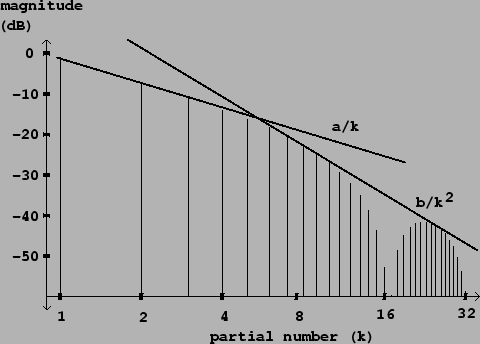
 . The two line
segments show
. The two line
segments show  and
and  behavior at
low and high frequencies.
behavior at
low and high frequencies.