


Now consider an arbitrary signal ![$X[n]$](img668.png) that
repeats every
that
repeats every  samples. (Previously we had assumed that
could be obtained as a sum of sinusoids,
and we haven't yet found out whether every periodic can be obtained that way.) Let
samples. (Previously we had assumed that
could be obtained as a sum of sinusoids,
and we haven't yet found out whether every periodic can be obtained that way.) Let ![$Y[k]$](img1062.png) denote the Fourier transform of
denote the Fourier transform of  for
for
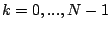 :
:
![\begin{displaymath} Y[k] = {\cal FT}\left \{ X[n] \right \} (k) \end{displaymath}](img1064.png)
![\begin{displaymath} = {{\left [ {U^{-k}} \right ]} ^ {0}} X[0] + {{\left [ {U^... ...X[1] + \cdots + {{\left [ {U^{-k}} \right ]} ^ {N-1}} X[N-1] \end{displaymath}](img1065.png)
![\begin{displaymath} = {{\left [ {U^{0}} \right ]} ^ {k}} X[0] + {{\left [ {U^{... ...1] + \cdots + {{\left [ {U^{-(N-1)}} \right ]} ^ {k}} X[N-1] \end{displaymath}](img1066.png) is a sum of complex sinusoids, with
complex amplitudes and frequencies
is a sum of complex sinusoids, with
complex amplitudes and frequencies
 for
for
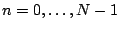 . In other words, can be considered as a Fourier series in its own right,
whose
. In other words, can be considered as a Fourier series in its own right,
whose  th component has strength
 ![$X[-m]$](img1068.png) . (The expression makes sense
because is a periodic signal). We can also express
the amplitude of the partials of in terms of its
own Fourier transform. Equating the two gives:
. (The expression makes sense
because is a periodic signal). We can also express
the amplitude of the partials of in terms of its
own Fourier transform. Equating the two gives:![\begin{displaymath} {1 \over N} {\cal FT} \left \{ Y[k] \right \} (m) = X[-m] \end{displaymath}](img1069.png) can be obtained by
summing sinusoids with amplitudes
can be obtained by
summing sinusoids with amplitudes ![$Y[k]/N$](img1070.png) .
Replacing with its negative gives:
.
Replacing with its negative gives:![\begin{displaymath} X[m] = {1 \over N} {\cal FT} \left \{ Y[k] \right \} (-m) \end{displaymath}](img1071.png)
![\begin{displaymath} = {{\left [ {U^{0}} \right ]} ^ {m}} X[0] + {{\left [ {U^{... ...X[1] + \cdots + {{\left [ {U^{N-1}} \right ]} ^ {m}} X[N-1] \end{displaymath}](img1072.png) can indeed be
obtained as a sum of sinusoids. Further, the formula explicitly
shows how to reconstruct from its Fourier
transform , if we know its value for the
integers
can indeed be
obtained as a sum of sinusoids. Further, the formula explicitly
shows how to reconstruct from its Fourier
transform , if we know its value for the
integers
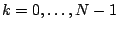 .
.