


Complex numbers are written
as:

 and
and  are real numbers and
 . (In this book we'll use the
upper case Roman letters such as
. (In this book we'll use the
upper case Roman letters such as  to denote complex
numbers. Real numbers appear as lower case Roman or Greek letters,
except for integer bounds, usually written as
to denote complex
numbers. Real numbers appear as lower case Roman or Greek letters,
except for integer bounds, usually written as  or
or
 .) Since a complex number has two real
components, we use a Cartesian plane (in place of a number line) to
graph it, as shown in Figure 7.1. The
quantities and are called the
real and imaginary parts of , written
as:
.) Since a complex number has two real
components, we use a Cartesian plane (in place of a number line) to
graph it, as shown in Figure 7.1. The
quantities and are called the
real and imaginary parts of , written
as:

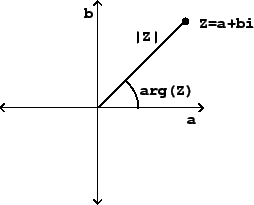 |
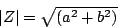
If is a complex number, its magnitude (or
absolute value), written as  ,
is just the distance in the plane from the origin to the point
,
is just the distance in the plane from the origin to the point
 :
:
 , is the angle from the positive
axis to the point :
, is the angle from the positive
axis to the point :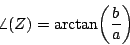
 and
and  ) we can
reconstruct the real and imaginary parts:
) we can
reconstruct the real and imaginary parts:
 and , as
  (this is called rectangular form), or alternatively in polar form, in terms of
and :
(this is called rectangular form), or alternatively in polar form, in terms of
and :![\begin{displaymath} Z = r \cdot \left[ \cos(\theta) + i \sin(\theta) \right ] \end{displaymath}](img638.png) and from and and vice
versa.
and from and and vice
versa.
The main reason we use complex numbers in electronic music is
because they magically automate trigonometric calculations. We
frequently have to add angles together in order to talk about the
changing phase of an audio signal as time progresses (or as it is
shifted in time, as in this chapter). It turns out that, if you
multiply two complex numbers, the argument of the product is the
sum of the arguments of the two factors. To see how this happens,
we'll multiply two numbers  and
and  , written in polar form:
![\begin{displaymath} {Z_1} = {r_1} \cdot \left [ \cos({\theta_1}) + i \sin({\theta_1}) \right ] \end{displaymath}](img641.png)
![\begin{displaymath} {Z_2} = {r_2} \cdot \left [ \cos({\theta_2}) + i \sin({\theta_2}) \right ] \end{displaymath}](img642.png)

![\begin{displaymath} { \left . { + i \left ( \sin({\theta_1}) \cos({\theta_2}) + \cos({\theta_1}) \sin({\theta_2}) \right ) } \right ] } \end{displaymath}](img644.png)
 term comes
from multiplying
term comes
from multiplying  by itself, which gives
  . We can spot the cosine and sine summation formulas in the
above expression, and so it simplifies to:
. We can spot the cosine and sine summation formulas in the
above expression, and so it simplifies to:![\begin{displaymath} {Z_1}{Z_2} = {r_1}{r_2} \cdot \left[ \cos({\theta_1}+{\theta_2}) + i \sin({\theta_1}+{\theta_2}) \right ] \end{displaymath}](img647.png)
 has magnitude
  and argument
 .
.
We can use this property of complex numbers to add and subtract angles (by multiplying and dividing complex numbers with the appropriate arguments) and then to take the cosine and sine of the result by extracting the real and imaginary parts.