


In most applications, we start with a real-valued signal to
filter and we need a real-valued output, but in general, a compound
filter with a transfer function as above will give a complex-valued
output. However, we can construct filters with non-real-valued
coefficients which nonetheless give real-valued outputs, so that
the analysis that we carry out using complex numbers can be used to
predict, explain, and control real-valued output signals. We do
this by pairing each elementary filter (with coefficient
 or
or  ) with another having
as its coefficient the complex conjugate
) with another having
as its coefficient the complex conjugate  or
or  .
.
For example, putting two non-recirculating filters, with
coefficients and , in
series gives a transfer function equal to:




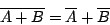

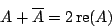
 and
and  in the compound filter is either
real-valued, or else appears in a pair with its complex conjugate.
in the compound filter is either
real-valued, or else appears in a pair with its complex conjugate.