


Sometimes an audio signal carries an unwanted constant offset, or in other words, a zero-frequency component. For example, the waveshaping spectra of Section 5.3 almost always contain a constant component. This is inaudible, but, since it specifies electrical power that is sent to your speakers, its presence reduces the level of loudness you can reach without distortion. Another name for a constant signal component is ``DC", meaning ``direct current".
An easy and practical way to remove the zero-frequency component
from an audio signal is to use a one-pole low-pass filter to
extract it, and then subtract the result from the signal. The
resulting transfer function is one minus the transfer function of
the low-pass filter:

 in the numerator of the low-pass
transfer function is the normalization factor needed so that the
gain is one at zero frequency.
in the numerator of the low-pass
transfer function is the normalization factor needed so that the
gain is one at zero frequency.
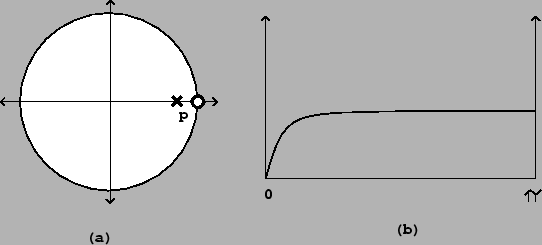
By examining the right-hand side of the equation (comparing it
to the general formula for compound filters), we see that there is
still a pole at the real number  , and there is now
also a zero at the point
, and there is now
also a zero at the point  . The pole-zero plot is shown
in Figure 8.13 (part a), and the frequency
response in part (b). (Henceforth, we will only plot frequency
responses to the Nyquist frequency
. The pole-zero plot is shown
in Figure 8.13 (part a), and the frequency
response in part (b). (Henceforth, we will only plot frequency
responses to the Nyquist frequency  ; in the
previous example we plotted it all the way up to the sample rate,
; in the
previous example we plotted it all the way up to the sample rate,
 .)
.)
 |