Let ![$X[n]=1$](img1077.png) for all
for all  (this repeats
with any desired integer period
(this repeats
with any desired integer period  ). From the
preceding discussion, we expect to find that
). From the
preceding discussion, we expect to find that
![\begin{displaymath} {\cal FT} \left \{ X[n] \right \} (k) = \left \{ \begin{... ...} N & {k=0} \ 0 & {k=1, \ldots, N-1} \end{array} \right . \end{displaymath}](img1079.png)
 however, and for this there is nothing
better to do than to calculate the value directly:
however, and for this there is nothing
better to do than to calculate the value directly:![\begin{displaymath} {\cal FT}\left \{ X[n] \right \} (k) = {V ^ {0}} X[0] + {V ^ {1}} X[1] + \cdots + {V ^ {N-1}} X[N-1] \end{displaymath}](img1057.png)
 is, as before, the unit magnitude complex
number with argument
is, as before, the unit magnitude complex
number with argument  . This is a geometric
series; as long as
. This is a geometric
series; as long as  we get:
![\begin{displaymath} {\cal FT} \left \{ X[n] \right \} (k) = {{ {V^N} - 1 } \over { V - 1 }} \end{displaymath}](img1081.png)

 . Then factoring appropriate
powers of
. Then factoring appropriate
powers of  out of the numerator and denominator
gives:
out of the numerator and denominator
gives:![\begin{displaymath} {\cal FT} \left \{ X[n] \right \} (k) = {\xi^{N-1}} {{ {\xi^N} - {\xi^{-N}} } \over { \xi - {\xi^{-1}} }} \end{displaymath}](img1085.png)

![\begin{displaymath} {\cal FT} \left \{ X[n] \right \} (k) = \left ( { \parbo... ... } \right ) {{ \sin(\pi k) } \over { \sin(\pi k / N) }} \end{displaymath}](img1087.png)
 or not, we have
![\begin{displaymath} {\cal FT} \left \{ X[n] \right \} (k) = \left ( { \parbo... ...(\pi k (N-1)/N) - i \sin(\pi k (N-1)/N) } \right ) {D_N}(k) \end{displaymath}](img1089.png)
 , known as the Dirichlet kernel, is defined as
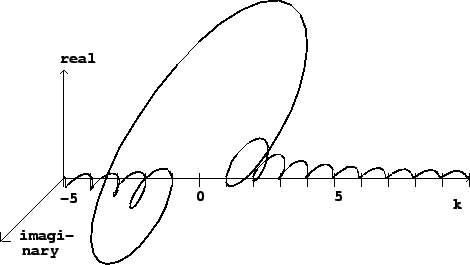
Figure 9.1 shows the Fourier transform
of , with  . The
transform repeats every 100 samples, with a peak at
. The
transform repeats every 100 samples, with a peak at  , another at
  , and so on. The figure
endeavors to show both the magnitude and phase behavior using a
3-dimensional graph projected onto the page. The phase term
, and so on. The figure
endeavors to show both the magnitude and phase behavior using a
3-dimensional graph projected onto the page. The phase term

![${\cal FT} \left \{ X[n] \right \} (k)$](img1095.png) around
the axis with a period of approximately two. The
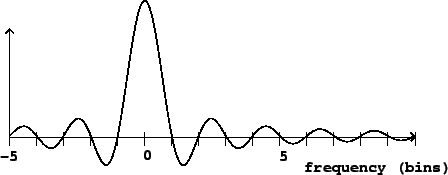
Dirichlet kernel , shown in Figure 9.2, controls the magnitude of
. It
has a peak, two units wide, around . This is
surrounded by one-unit-wide sidelobes, alternating in sign and gradually
decreasing in magnitude as increases or
decreases away from zero. The phase term rotates by almost
around
the axis with a period of approximately two. The
Dirichlet kernel , shown in Figure 9.2, controls the magnitude of
. It
has a peak, two units wide, around . This is
surrounded by one-unit-wide sidelobes, alternating in sign and gradually
decreasing in magnitude as increases or
decreases away from zero. The phase term rotates by almost
 radians each time the Dirichlet kernel
changes sign, so that the product of the two stays roughly in the
same complex half-plane for
radians each time the Dirichlet kernel
changes sign, so that the product of the two stays roughly in the
same complex half-plane for  (and in the
opposite half-plane for
(and in the
opposite half-plane for  ). The phase rotates
by almost
). The phase rotates
by almost  radians over the peak from
 to
to  .
.
 |
 = 100.