


Next: Square and
symmetric triangle Up: Fourier series of the Previous: Sawtooth wave
Contents
Index
The same analysis, with some differences in sign and normalization,
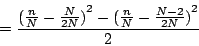
works for parabolic waves. First we compute the difference:
So (again for  , small compared to
  ) we get:
and as before we get the Fourier series:
Miller Puckette 2006-12-30
![\begin{displaymath} p[n] - p[n-1] = { { {{({n\over N} - {1\over 2})}^2} - {{({{n-1}\over N} - {1\over 2})}^2} } \over { 2 }} \end{displaymath}](img1326.png)
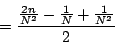
![\begin{displaymath} \approx - s[n] / N . \end{displaymath}](img1329.png)
![\begin{displaymath} {\cal FT}\{ p[n] \} (k) \approx {{-1} \over N} \cdot {{-iN} \over {2 \pi k}} \cdot {\cal FT}\{ s[n] \} (k) \end{displaymath}](img1330.png)
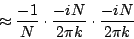

![\begin{displaymath} p[n] \approx {1 \over {2 {\pi^2}}} \left [ {\cos ( \omega ... ...\over 4} + {{\cos ( 3 \omega n)} \over 9} + \cdots \right ] \end{displaymath}](img1333.png)