


``Sampling" is nothing more than recording a live signal into a wavetable, and then later playing it out again. (In commercial samplers the entire wavetable is usually called a ``sample" but to avoid confusion we'll only use the word ``sample" here to mean a single number in an audio signal.)
At its simplest, a sampler is simply a wavetable oscillator, as was shown in Figure 2.3. However, in the earlier discussion we imagined playing the oscillator back at a frequency high enough to be perceived as a pitch, at least 30 Hertz or so. In the case of sampling, the frequency is usually lower than 30 Hertz, and so the period, at least 1/30 second and perhaps much more, is long enough that you can hear the individual cycles as separate events.
Going back to Figure 2.2,
suppose that instead of 40 points the wavetable ![$x[n]$](img80.png) is a one-second recording, at an original sample rate of 44100, so
that it has 44100 points; and let
is a one-second recording, at an original sample rate of 44100, so
that it has 44100 points; and let ![$y[n]$](img2.png) in part (b)
of the figure have a period of 22050 samples. This corresponds to a
frequency of 2 Hertz. But what we hear is not a pitched sound at 2
cycles per second (that's too slow to hear as a pitch) but rather,
we hear the original recording played back
repeatedly at double speed. We've just reinvented the sampler.
in part (b)
of the figure have a period of 22050 samples. This corresponds to a
frequency of 2 Hertz. But what we hear is not a pitched sound at 2
cycles per second (that's too slow to hear as a pitch) but rather,
we hear the original recording played back
repeatedly at double speed. We've just reinvented the sampler.
In general, if we assume the sample rate  of the
recording is the same as the output sample rate, if the wavetable
has
of the
recording is the same as the output sample rate, if the wavetable
has  samples, and if we index it with a sawtooth
wave of period
samples, and if we index it with a sawtooth
wave of period  , the sample is sped up or slowed
down by a factor of
, the sample is sped up or slowed
down by a factor of  , equal to
  if
if  is the frequency in Hertz of the
sawtooth. If we denote the transposition factor by
is the frequency in Hertz of the
sawtooth. If we denote the transposition factor by  (so that, for instance,
  means transposing upward
a perfect fifth), and if we denote the transposition in half-steps
by
means transposing upward
a perfect fifth), and if we denote the transposition in half-steps
by  , then we get the Transposition Formulas for Looping Wavetables:
 )
is known and the formula must be solved for either
or :
)
is known and the formula must be solved for either
or :

So far we have used a sawtooth as the input wave ![$y[t]$](img199.png) , but, as suggested in parts (d) and (e) of Figure
2.2, we could use anything we
like as an input signal. In general, the transposition may be time
dependent and is controlled by the rate of change of the input
signal.
, but, as suggested in parts (d) and (e) of Figure
2.2, we could use anything we
like as an input signal. In general, the transposition may be time
dependent and is controlled by the rate of change of the input
signal.
The transposition multiple and the
transposition in half-steps are then given by
the Momentary Transposition Formulas
for Wavetables:
![\begin{displaymath} t[n] = \left \vert y[n] - y[n-1] \right \vert \end{displaymath}](img200.png)
![\begin{displaymath} h[n] = 12 {{\log_2} \left \vert y[n] - y[n-1] \right \vert} \end{displaymath}](img201.png)
 " mean absolute
value.) For example, if
" mean absolute
value.) For example, if ![$y[n] = n$](img203.png) , then
, then ![$z[n] = x[n]$](img204.png) so we hear the wavetable at its original pitch,
and this is what the formula predicts since, in that case,
so we hear the wavetable at its original pitch,
and this is what the formula predicts since, in that case,![\begin{displaymath} y[n]-y[n-1] = 1 \end{displaymath}](img205.png)
![$y[n] = 2n$](img206.png) , then the wavetable
is transposed up an octave, consistent with
, then the wavetable
is transposed up an octave, consistent with![\begin{displaymath} y[n]-y[n-1] = 2 \end{displaymath}](img207.png) are decreasing with
are decreasing with  ,
you hear the sample backward, but the transposition formula still
gives a positive multiplier. This all agrees with the earlier
Transposition Formula for Looping Wavetables; if a sawtooth ranges
from
,
you hear the sample backward, but the transposition formula still
gives a positive multiplier. This all agrees with the earlier
Transposition Formula for Looping Wavetables; if a sawtooth ranges
from  to ,
times per second, the difference of successive samples is just
--except at the sample at the
beginning of each new cycle.
to ,
times per second, the difference of successive samples is just
--except at the sample at the
beginning of each new cycle.
It's well known that transposing a recording also transposes its timbre--this is the ``chipmunk" effect. Not only are any periodicities (such as might give rise to pitch) transposed, but so are the frequencies of the overtones. Some timbres, notably those of vocal sounds, have characteristic frequency ranges in which overtones are stronger than other nearby ones. Such frequency ranges are also transposed, and this is is heard as a timbre change. In language that will be made more precise in Section 5.1, we say that the spectral envelope is transposed along with the pitch or pitches.
In both this and the preceding section, we have considered playing wavetables periodically. In Section 2.1 the playback repeated quickly enough that the repetition gives rise to a pitch, say between 30 and 4000 times per second, roughly the range of a piano. In the current section we assumed a wavetable one second long, and in this case ``reasonable" transposition factors (less than four octaves up) would give rise to a rate of repetition below 30, usually much lower, and going down as low as we wish.
The number 30 is significant for another reason: it is roughly the maximum number of separate events the ear can discern per second; for instance, 30 vocal phonemes, or melodic notes, or attacks of a snare drum are about the most we can hope to crowd into a second before our ability to distinguish them breaks down.
A continuum exists between samplers and wavetable oscillators, in that the patch of Figure 2.3 can either be regarded as a sampler (if the frequency of repetition is less than about 20 Hertz) or as a wavetable oscillator (if the frequency is greater than about 40 Hertz). It is possible to move continuously between the two regimes. Furthermore, it is not necessary to play an entire wavetable in a loop; with a bit more arithmetic we can choose sub-segments of the wavetable, and these can change in length and location continuously as the wavetable is played.
The practice of playing many small segments of a wavetable in rapid succession is often called granular synthesis. For much more discussion of the possibilities, see [Roa01].
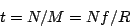
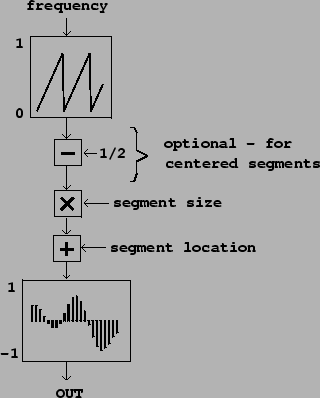
Figure 2.5 shows how to build a very
simple looping sampler. In the figure, if the frequency is
and the segment size in samples is
 , the output transposition factor is given
by
, the output transposition factor is given
by  , where R is the sample rate at which
the wavetable was recorded (which need not equal the sample rate
the block diagram is working at.) In practice, this equation must
usually be solved for either or
to attain a desired transposition.
, where R is the sample rate at which
the wavetable was recorded (which need not equal the sample rate
the block diagram is working at.) In practice, this equation must
usually be solved for either or
to attain a desired transposition.
In the figure, a sawtooth oscillator controls the location of wavetable lookup, but the lower and upper values of the sawtooth aren't statically specified as they were in Figure 2.3; rather, the sawtooth oscillator simply ranges from 0 to 1 in value and the range is adjusted to select a desired segment of samples in the wavetable.
It might be desirable to specify the segment's location
 either as its left-hand edge (its lower
bound) or else as the segment's midpoint; in either case we specify
the length as a separate parameter. In the first
case, we start by multiplying the sawtooth by ,
so that it then ranges from to ;
then we add so that it now ranges from to
either as its left-hand edge (its lower
bound) or else as the segment's midpoint; in either case we specify
the length as a separate parameter. In the first
case, we start by multiplying the sawtooth by ,
so that it then ranges from to ;
then we add so that it now ranges from to  . In order to specify the location as
the segment's midpoint, we first subtract
. In order to specify the location as
the segment's midpoint, we first subtract  from
the sawtooth (so that it ranges from
from
the sawtooth (so that it ranges from  to
), and then as before multiply by
(so that it now ranges from
to
), and then as before multiply by
(so that it now ranges from  to
to  ) and add to give a
range from
) and add to give a
range from  to
to  .
.
 |
In the looping sampler, we will need to worry about maintaining continuity between the beginning and the end of segments of the wavetable; we'll take this up in the next section.
A further detail is that, if the segment size and location are
changing with time (they might be digital audio signals themselves,
for instance), they will affect the transposition factor, and the
pitch or timbre of the output signal might waver up and down as a
result. The simplest way to avoid this problem is to synchronize
changes in the values of and with the
regular discontinuities of the sawtooth; since the signal jumps
discontinuously there, the transposition is not really defined
there anyway, and, if you are enveloping to hide the discontinuity,
the effects of changes in and
are hidden as well.