


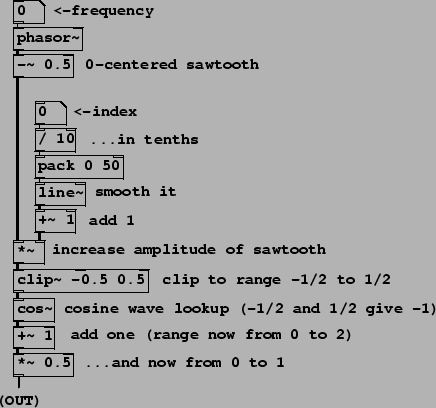
Example F01.pulse.pd (Figure 6.13)
generates a variable-width pulse train using stretched wavetable
lookup. Figure 6.14 shows two intermediate
products of the patch and its output. The patch carries out the job
in the simplest possible way, placing the pulse at phase
 instead of phase zero; in later examples
this will be fixed by adding 0.5 to the phase and wrapping.
instead of phase zero; in later examples
this will be fixed by adding 0.5 to the phase and wrapping.
 |
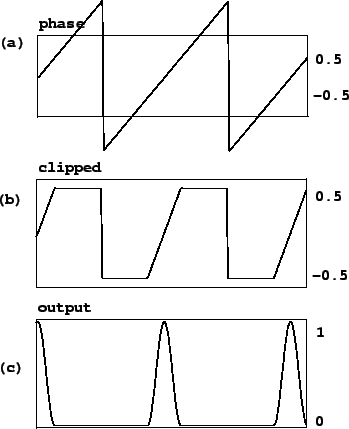 |
The initial phase is adjusted to run from -0.5 to 0.5 and then
scaled by a multiplier of at least one, resulting in the signal of
Figure 6.14 (part a); this corresponds to
the output of the *~ object, fifth from bottom in the
patch shown. The graph in part (b) shows the result of clipping the
sawtooth wave back to the interval between  and
and
 , using the clip~ object. If the
scaling multiplier were at its minimum (one), the sawtooth would
only range from -0.5 to 0.5 anyway and the clipping would have no
effect. For any value of the scaling multiplier greater than one,
the clipping output sits at the value -0.5, then ramps to 0.5, then
sits at 0.5. The higher the multiplier, the faster the waveform
ramps and the more time it spends clipped at the bottom and
top.
, using the clip~ object. If the
scaling multiplier were at its minimum (one), the sawtooth would
only range from -0.5 to 0.5 anyway and the clipping would have no
effect. For any value of the scaling multiplier greater than one,
the clipping output sits at the value -0.5, then ramps to 0.5, then
sits at 0.5. The higher the multiplier, the faster the waveform
ramps and the more time it spends clipped at the bottom and
top.
The cos~ object then converts this waveform into a pulse. Inputs of both -0.5 and 0.5 go to -1 (they are one cycle apart); at the midpoint of the waveform, the input is 0 and the output is thus 1. The output therefore sits at -1, traces a full cycle of the cosine function, then comes back to rest at -1. The proportion of time the waveform spends tracing the cosine function is one divided by the multiplier; so it's 100% for a multiplier of 1, 50% for 2, and so on. Finally, the pulse output is adjusted to range from 0 to 1 in value; this is graphed in part (c) of the figure.