In most widely used audio synthesis and processing packages
(Csound, Max/MSP, and Pd, for instance), the audio operations are
specified as networks of unit
generators[Mat69] which
pass audio signals among themselves. The user of the software
package specifies the network, sometimes called a patch, which essentially corresponds to the
synthesis algorithm to be used, and then worries about how to
control the various unit generators in time. In this section, we'll
use abstract block diagrams to describe patches, but in the
``examples" section (Page ![[*]](file:/usr/local/share/lib/latex2html/icons/crossref.png) ),
we'll choose a specific implementation environment and show some of
the software-dependent details.
),
we'll choose a specific implementation environment and show some of
the software-dependent details.
To show how to produce a sinusoid with time-varying amplitude we'll need to introduce two unit generators. First we need a pure sinusoid which is made with an oscillator. Figure 1.5 (part a) shows a pictorial representation of a sinusoidal oscillator as an icon. The input is a frequency (in cycles per second), and the output is a sinusoid of peak amplitude one.
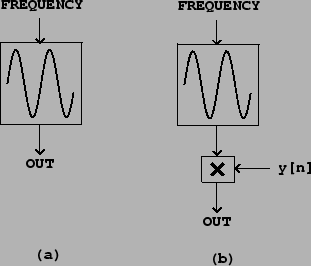 |
Figure 1.5 (part b) shows how to
multiply the output of a sinusoidal oscillator by an appropriate
scale factor ![$y[n]$](img2.png) to control its amplitude. Since the
oscillator's peak amplitude is 1, the peak amplitude of the product
is about , assuming changes
slowly enough and doesn't become negative in value.
to control its amplitude. Since the
oscillator's peak amplitude is 1, the peak amplitude of the product
is about , assuming changes
slowly enough and doesn't become negative in value.
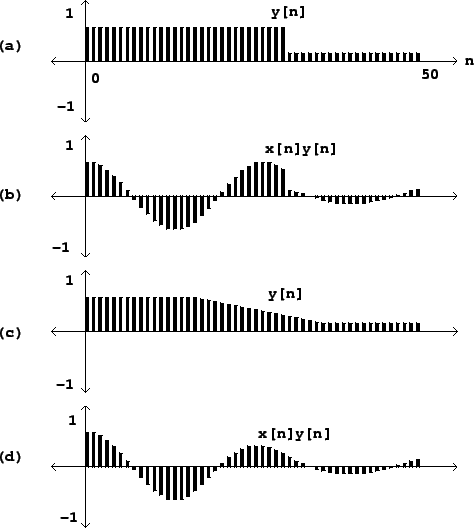 |
Figure 1.6 shows how the sinusoid of
Figure 1.1 is affected by
amplitude change by two different controlling signals . The controlling signal shown in part (a) has a
discontinuity, and so therefore does the resulting
amplitude-controlled sinusoid shown in (b). Parts (c) and (d) show
a more gently-varying possibility for and the
result. Intuition suggests that the result shown in (b) won't sound
like an amplitude-varying sinusoid, but instead like a sinusoid
interrupted by an audible ``pop" after which it continues more
quietly. In general, for reasons that can't be explained in this
chapter, amplitude control signals which ramp
smoothly from one value to another are less likely to give rise to
parasitic results (such as that ``pop") than are abruptly changing
ones.
For now we can state two general rules without justifying them. First, pure sinusoids are the signals most sensitive to the parasitic effects of quick amplitude change. So when you want to test an amplitude transition, if it works for sinusoids it will probably work for other signals as well. Second, depending on the signal whose amplitude you are changing, the amplitude control will need between 0 and 30 milliseconds of ``ramp" time--zero for the most forgiving signals (such as white noise), and 30 for the least (such as a sinusoid). All this also depends in a complicated way on listening levels and the acoustic context.
Suitable amplitude control functions may be made
using an envelope generator.
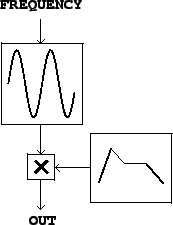
Figure 1.7 shows a network in which an
envelope generator is used to control the amplitude of an
oscillator. Envelope generators vary widely in design, but we will
focus on the simplest kind, which generates line segments as shown
in Figure 1.6 (part c). If a line segment
is specified to ramp between two output values  and
and
 over
over  samples starting at
sample number
samples starting at
sample number  , the output is:
![\begin{displaymath} y[n] = a + (b - a) {{n-M} \over N}, \hspace{0.1in} M \le n \le M+N-1. \end{displaymath}](img119.png)
 ;
flat, horizontal segments can be made by setting
;
flat, horizontal segments can be made by setting  .
.
In addition to changing amplitudes of sounds, amplitude control is often used, especially in real-time applications, simply to turn sounds on and off: to turn one off, ramp the amplitude smoothly to zero. Most software synthesis packages also provide ways to actually stop modules from computing samples at all, but here we'll use amplitude control instead.
The envelope generator dates from the analog era [Str95, p.64] [Cha80, p.90], as does the rest of Figure 1.7; oscillators with controllable frequency were called voltage-controlled oscillators or VCOs, and the multiplication step was done using a voltage-controlled amplifier or VCA [Str95, pp.34-35] [Cha80, pp.84-89]. Envelope generators are described in more detail in Section 4.1.