


Electronic music is usually made using a computer, by synthesizing or processing digital audio signals. These are sequences of numbers,
![\begin{displaymath} ..., x[n-1], x[n], x[n+1], ... \end{displaymath}](img74.png)
 , called the sample number, may range over some or all the
integers. A single number in the sequence is called a
sample. An example of a digital audio signal is the
Sinusoid:
, called the sample number, may range over some or all the
integers. A single number in the sequence is called a
sample. An example of a digital audio signal is the
Sinusoid: ![\begin{displaymath} x[n] = a \cos (\omega n + \phi ) \end{displaymath}](img76.png)
 is the amplitude,
  is the
angular frequency, and
is the
angular frequency, and
 is the initial phase. The phase
is a function of the sample number , equal to
is the initial phase. The phase
is a function of the sample number , equal to
 . The initial phase is the
phase at the zeroth sample (
. The initial phase is the
phase at the zeroth sample ( ).
).
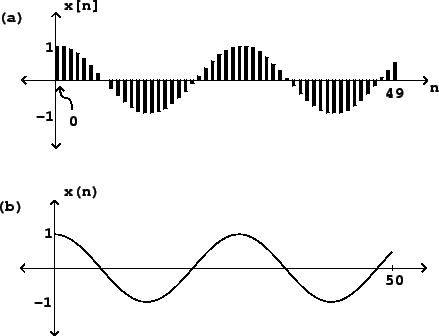
Figure 1.1 (part a) shows a sinusoid
graphically. The horizontal axis shows successive values of
and the vertical axis shows the
corresponding values of ![$x[n]$](img80.png) . The graph is drawn in
such a way as to emphasize the sampled nature of the signal.
Alternatively, we could draw it more simply as a continuous curve
(part b). The upper drawing is the most faithful representation of
the (digital audio) sinusoid, whereas the lower one can be
considered an idealization of it.
. The graph is drawn in
such a way as to emphasize the sampled nature of the signal.
Alternatively, we could draw it more simply as a continuous curve
(part b). The upper drawing is the most faithful representation of
the (digital audio) sinusoid, whereas the lower one can be
considered an idealization of it.
 |
Sinusoids play a key role in audio processing because, if you shift one of them left or right by any number of samples, you get another one. This makes it easy to calculate the effect of all sorts of operations on sinusoids. Our ears use this same special property to help us parse incoming sounds, which is why sinusoids, and combinations of sinusoids, can be used to achieve many musical effects.
Digital audio signals do not have any intrinsic relationship
with time, but to listen to them we must choose a sample rate, usually given the variable name
 , which is the number of samples that fit
into a second. The time
, which is the number of samples that fit
into a second. The time  is related to the sample
number by
is related to the sample
number by  , or
, or  . A sinusoidal signal with angular frequency
has a real-time frequency equal
to
. A sinusoidal signal with angular frequency
has a real-time frequency equal
to

 radians and a second is samples.
A real-world audio signal's amplitude might be expressed as a time-varying voltage or air pressure, but the samples of a digital audio signal are unitless numbers. We'll casually assume here that there is ample numerical accuracy so that we can ignore round-off errors, and that the numerical format is unlimited in range, so that samples may take any value we wish. However, most digital audio hardware works only over a fixed range of input and output values, most often between -1 and 1. Modern digital audio processing software usually uses a floating-point representation for signals. This allows us to use whatever units are most convenient for any given task, as long as the final audio output is within the hardware's range [Mat69, pp. 4-10].