


As mentioned before, interpolation schemes are often used to increase the accuracy of table lookup. Here we will give a somewhat simplified account of the effects of table sizes and interpolation schemes on the result of table lookup.
To speak of error in table lookup, we must view the wavetable as
a sampled version of an underlying function. When we ask for a
value of the underlying function which lies between the points of
the wavetable, the error is the difference between the result of
the wavetable lookup and the ``ideal" value of the function at that
point. The most revealing study of wavetable lookup error assumes
that the underlying function is a sinusoid (Page ![[*]](file:/usr/local/share/lib/latex2html/icons/crossref.png) ). We
can then understand what happens to other wavetables by considering
them as superpositions (sums) of sinusoids.
). We
can then understand what happens to other wavetables by considering
them as superpositions (sums) of sinusoids.
The accuracy of lookup from a wavetable containing a sinusoid depends on two factors: the quality of the interpolation scheme, and the period of the sinusoid. In general, the longer the period of the sinusoid, the more accurate the result.
In the case of a synthetic wavetable, we might know its sinusoidal components from having specified them--in which case the issue becomes one of choosing a wavetable size appropriately, when calculating the wavetable, to match the interpolation algorithm and meet the desired standard of accuracy. In the case of recorded sounds, the accuracy analysis might lead us to adjust the sample rate of the recording, either at the outset or else by resampling later.
Interpolation error for a sinusoidal wavetable can have two components: first, the continuous signal (the theoretical result of reading the wavetable continuously in time, as if the output sample rate were infinite) might not be a pure sinusoid; and second, the amplitude might be wrong. (It is possible to get phase errors as well, but only through carelessness.)
In this treatment we'll only consider polynomial interpolation
schemes such as rounding, linear interpolation, and cubic
interpolation. These schemes amount to evaluating polynomials (of
degree zero, one, and three, respectively) in the interstices
between points of the wavetable. The idea is that, for any index
 , we choose a nearby reference point
 , and let the output be calculated by
some polynomial:
, and let the output be calculated by
some polynomial:

 nearest points of the wavetable. For
1-point interpolation (a zero-degree polynomial) this means letting
nearest points of the wavetable. For
1-point interpolation (a zero-degree polynomial) this means letting
 equal the nearest point of the wavetable.
For two-point interpolation, we draw a line segment between the two
points of the wavetable on either side of the desired point
. We can let
equal the nearest point of the wavetable.
For two-point interpolation, we draw a line segment between the two
points of the wavetable on either side of the desired point
. We can let  be the
closest integer to the left of (which we write as
be the
closest integer to the left of (which we write as
 ) and then the formula for
linear interpolation is:
) and then the formula for
linear interpolation is:![\begin{displaymath} {y_{\mathrm{INT}}}(x) = y[{x_0}] + (y[{x_0} + 1]- y[{x_0}]) \cdot (x - {x_0}) \end{displaymath}](img249.png)
![\begin{displaymath} {a_0} = y[{x_0}] \end{displaymath}](img250.png)
![\begin{displaymath} {a_1} = y[{x_0} + 1]- y[{x_0}] \end{displaymath}](img251.png)
 through any
  points as long
as their values are all different.
points as long
as their values are all different.
Figure 2.11 shows the effect of using linear (two-point) interpolation to fill in a sinusoid of period 6. At the top are three traces: the original sinusoid, the linearly-interpolated result of using 6 points per period to represent the sinusoid, and finally, another sinusoid, of slightly smaller amplitude, which better matches the six-segment waveform. The error introduced by replacing the original sinusoid by the linearly interpolated version has two components: first, a (barely perceptible) change in amplitude, and second, a (very perceptible) distortion of the wave shape.
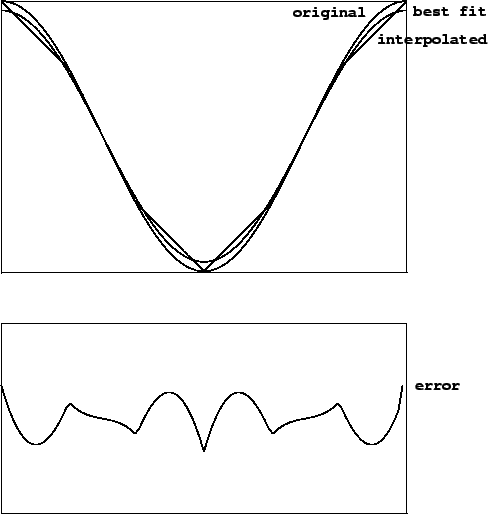 |
The bottom graph in the figure shows the difference between the interpolated waveform and the best-fitting sinusoid. This is a residual signal all of whose energy lies in overtones of the original sinusoid. As the number of points increases, the error decreases in magnitude. Since the error is the difference between a sinusoid and a sequence of approximating line segments, the magnitude of the error is roughly proportional to the square of the phase difference between each pair of points, or in other words, inversely proportional to the square of the number of points in the wavetable. Put another way, wavetable error decreases by 12 dB each time the table doubles in size. (This rule of thumb is only good for tables with 4 or more points.)
Four-point (cubic) interpolation works similarly. The
interpolation formula is:

![\begin{displaymath} -f (f-1)(f-2)/6 \cdot y[{x_0}-1] + (f+1)(f-1)(f-2)/2 \cdot y[{x_0}] \end{displaymath}](img255.png)
![\begin{displaymath} - (f+1) f (f-2) / 2 \cdot y[{x_0}+1] + (f+1) f (f-1) / 6 \cdot y[{x_0}+2] \end{displaymath}](img256.png)
 is the fractional part of the
index. For tables with 4 or more points, doubling the number of
points on the table tends to improve the RMS error by 24 dB. Table
2.1 shows the calculated RMS error for sinusoids at various periods
for 1, 2, and 4 point interpolation. (A slightly different quantity
is measured in [Moo90, p.164].
There, the errors in amplitude and phase are also added in,
yielding slightly more pessimistic results. See also [Har87].)
is the fractional part of the
index. For tables with 4 or more points, doubling the number of
points on the table tends to improve the RMS error by 24 dB. Table
2.1 shows the calculated RMS error for sinusoids at various periods
for 1, 2, and 4 point interpolation. (A slightly different quantity
is measured in [Moo90, p.164].
There, the errors in amplitude and phase are also added in,
yielding slightly more pessimistic results. See also [Har87].)
The allowable input domain for table lookup depends on the
number of points of interpolation. In general, when using
 -point interpolation into a table with
 points, the input may range over an interval
of
points, the input may range over an interval
of  points. If
  (i.e.,
no interpolation at all), the domain is from
(i.e.,
no interpolation at all), the domain is from  to (including the endpoint at
but excluding the one at ) assuming input values are
truncated (as is done for non-interpolated table lookup in Pd). The
domain is from -
to (including the endpoint at
but excluding the one at ) assuming input values are
truncated (as is done for non-interpolated table lookup in Pd). The
domain is from - to
to  if,
instead, we round the input to the nearest integer instead of
interpolating. In either case, the domain stretches over a length
of points.
if,
instead, we round the input to the nearest integer instead of
interpolating. In either case, the domain stretches over a length
of points.
For two-point interpolation, the input must lie between the
first and last points, that is, between and
 . So the points suffice
to define the function over a domain of length . For four-point interpolation, we cannot get values for
inputs between 0 and 1 (not having the required two points to the
left of the input) and neither can we for the space between the
last two points (
. So the points suffice
to define the function over a domain of length . For four-point interpolation, we cannot get values for
inputs between 0 and 1 (not having the required two points to the
left of the input) and neither can we for the space between the
last two points ( and ). So in
this case the domain reaches from
and ). So in
this case the domain reaches from  to
and has length
to
and has length  .
.
Periodic waveforms stored in wavetables require special
treatment at the ends of the table. For example, suppose we wish to
store a pure sinusoid of length . For
non-interpolating table lookup, it suffices to set, for
example,
![\begin{displaymath} x[n] = \cos(2 \pi n / N) ,\, n = 0, \ldots, N-1 \end{displaymath}](img264.png)
 points:
![\begin{displaymath} x[n] = \cos(2 \pi n / N) ,\, n = 0, \ldots, N \end{displaymath}](img266.png)
 ) point
at the end, so that the last segment from to
reaches back to the beginning value.
) point
at the end, so that the last segment from to
reaches back to the beginning value.
For four-point interpolation, the cycle must be adjusted to
start at the point  , since we can't get
properly interpolated values out for inputs less than one. If,
then, one cycle of the wavetable is arranged from
to , we must supply extra points for (copied from ), and also
and
, since we can't get
properly interpolated values out for inputs less than one. If,
then, one cycle of the wavetable is arranged from
to , we must supply extra points for (copied from ), and also
and  , copied from and
 , to make a table of length
  . For the same sinusoid as above, the table should
contain:
. For the same sinusoid as above, the table should
contain:
![\begin{displaymath} x[n] = \cos(2 \pi (n-1) / N) ,\, n = 0, \ldots, N+2 \end{displaymath}](img271.png)