


The examples for this chapter will use Pd's abstraction mechanism, which permits the building of patches that may be reused any number of times. One or more object boxes in a Pd patch may be subpatches, which are separate patches encapsulated inside the boxes. These come in two types: one-off subpatches and abstractions. In either case the subpatch appears as an object box in the parent patch.
If you type ``pd" or ``pd my-name" into an object box, this creates a one-off subpatch. The contents of the subpatch are saved as part of the parent patch, in one file. If you make several copies of a subpatch you may change them individually. On the other hand, you can invoke an abstraction by typing into the box the name of a Pd patch saved to a file (without the ``.pd" extension). In this situation Pd will read that file into the subpatch. In this way, changes to the file propagate everywhere the abstraction is invoked.
Object boxes in the subpatch (either one-off or abstractions) may create inlets and outlets on the box in the parent patch. This is done with the following classes of objects:
 ,
,
 : create inlets for the
object box containing the subpatch. The
: create inlets for the
object box containing the subpatch. The
 version creates an inlet
for audio signals, whereas
version creates an inlet
for audio signals, whereas
 creates one for control
streams. In either case, whatever shows up on the inlet of the box
in the parent patch comes out of the
object in the subpatch.
creates one for control
streams. In either case, whatever shows up on the inlet of the box
in the parent patch comes out of the
object in the subpatch.
 ,
,
 : Corresponding objects
for output from subpatches.
: Corresponding objects
for output from subpatches.
Pd provides an argument-passing mechanism so that you can
parametrize different invocations of an abstraction. If in an
object box you type ``$1", it is expanded to mean
``the first creation argument in my box on the parent patch", and
similarly for ``$2" and so on. The text in an object
box is interpreted at the time the box is created, unlike the text
in a message box. In message boxes, the same ``$1"
means ``the first argument of the message I just received" and is
interpreted whenever a new message comes in.
An example of an abstraction, using inlets, outlets, and
parametrization, is shown in figure 4.11. In part (a), a patch invokes
``plusminus" in an object box, with a creation argument equal to 5.
The number 8 is fed to the
 object, and out comes the
sum and difference of 8 and 5.
object, and out comes the
sum and difference of 8 and 5.
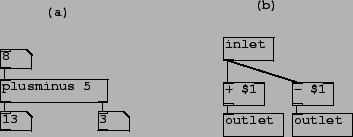 |
The
object is not defined by
Pd, but is rather defined by the patch residing in the file named
``plusminus.pd". This patch is shown in part (b) of the figure. The
one
and two
 objects correspond to the
inlets and outlets of the
object. The two
``
objects correspond to the
inlets and outlets of the
object. The two
``$1 arguments (to the  and
and
 objects) are replaced by 5 (the creation
argument of the
object).
objects) are replaced by 5 (the creation
argument of the
object).
We have already seen one abstraction in the examples: the
 object introduced in
chapter 1, Figure 1.8(c). This
shows an additional feature of abstractions, that they may display
controls as part of their boxes on the parent patch; see the Pd
documentation for a description of this feature.
object introduced in
chapter 1, Figure 1.8(c). This
shows an additional feature of abstractions, that they may display
controls as part of their boxes on the parent patch; see the Pd
documentation for a description of this feature.