


We return now to the spectra computed on Page ![[*]](file:/usr/share/latex2html/icons/crossref.png) ,
corresponding to waveshaping functions of the form
,
corresponding to waveshaping functions of the form  . We note with pleasure that not only are they all
in phase (so that they can be superposed with easily predictable
results) but also that the spectra spread out increasingly with
. We note with pleasure that not only are they all
in phase (so that they can be superposed with easily predictable
results) but also that the spectra spread out increasingly with
 . Also, in a series of the form,

 , the terms are
  multiplied by
  ,
,  ,
,  , and so on.
Now suppose we wish to arrange for different terms in the above
expansion to dominate the result in a predictable way as a function
of the index . To choose the simplest possible example,
suppose we wish to be the largest term for
 , then for it to be overtaken by
the more quickly growing term for
, then for it to be overtaken by
the more quickly growing term for  , which is then overtaken by the term for
  and so on, so that
the
and so on, so that
the  th term takes over at an index equal to
. To make this happen we just require
that
th term takes over at an index equal to
. To make this happen we just require
that
 at 1, we get
  ,
,
 ,
,  , and in
general,
, and in
general,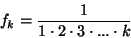

 is Euler's constant.
Before plugging in  as a transfer function
it's wise to plan how we will deal with signal amplitude, since
grows quickly as a function of
as a transfer function
it's wise to plan how we will deal with signal amplitude, since
grows quickly as a function of
 . If we're going to plug in a sinusoid of
amplitude , the maximum output will be
. If we're going to plug in a sinusoid of
amplitude , the maximum output will be  , occuring whenever the phase is zero. A simple and natural
choice is simply to divide by to reduce the
peak to one, giving:
, occuring whenever the phase is zero. A simple and natural
choice is simply to divide by to reduce the
peak to one, giving:
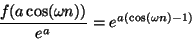
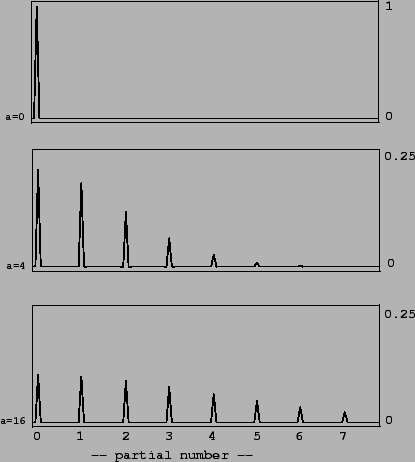
 0, 4, and 16 are shown in Figure 5.13. As the waveshaping index rises,
progressively less energy is present in the fundamental; the energy
is increasingly spread over the partials.
0, 4, and 16 are shown in Figure 5.13. As the waveshaping index rises,
progressively less energy is present in the fundamental; the energy
is increasingly spread over the partials.
 |