


As suggested in Section 5.2, when considering the result of
modulating a complex harmonic (i.e., periodic) signal by a
sinusoid, an interesting special case is to set the modulating
oscillator to  the fundamental frequency, which drops
the resulting sound an octave with only a relatively small
deformation of the spectral envelope. Another is to modulate by a
sinusoid at several times the fundamental frequency, which in
effect displaces the spectral envelope without changing the
fundamental frequency of the result. This is demonstrated in Patch
E03.octave.divider.pd(Figure 5.10). The
signal we process here is a recorded, spoken voice.
the fundamental frequency, which drops
the resulting sound an octave with only a relatively small
deformation of the spectral envelope. Another is to modulate by a
sinusoid at several times the fundamental frequency, which in
effect displaces the spectral envelope without changing the
fundamental frequency of the result. This is demonstrated in Patch
E03.octave.divider.pd(Figure 5.10). The
signal we process here is a recorded, spoken voice.
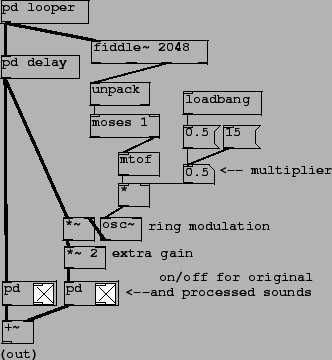 |
The subpatches pd looper and pd delay hide details. The first is a looping sampler as introduced in Chapter 2. The second is a delay of 1024 samples, which uses objects that are introduced later in chapter 7. We will introduce one object class here.
 : pitch tracker. The one inlet takes a signal to analyze,
and messages to change settings. Depending on its creation
arguments fiddle~may have a variable number of outlets
offering various information about the input signal. As shown here,
with only one creation argument to specify window size, the third
outlet attempts to report the pitch of the input, and the amplitude
of that portion of the input which repeats (at least approximately)
at the reported pitch. These are reported as a list of two numbers.
The pitch, which is in MIDI units, is reported as zero if none
could be identified.
: pitch tracker. The one inlet takes a signal to analyze,
and messages to change settings. Depending on its creation
arguments fiddle~may have a variable number of outlets
offering various information about the input signal. As shown here,
with only one creation argument to specify window size, the third
outlet attempts to report the pitch of the input, and the amplitude
of that portion of the input which repeats (at least approximately)
at the reported pitch. These are reported as a list of two numbers.
The pitch, which is in MIDI units, is reported as zero if none
could be identified.
In this patch the third outlet is unpacked into
its pitch and amplitude components, and the pitch component is
filtered by the moses object so that only successful pitch
estimates (nonzero ones) are considered. These are converted to
units of frequency by the mtof object. Finally, the
frequency estimates are either reduced by or else
multiplied by 15, depending on the selected multiplier, to provide
the modulation frequency. In the first case we get an octave
divider, and in the second, additional high harmonics that deform
the vowels.