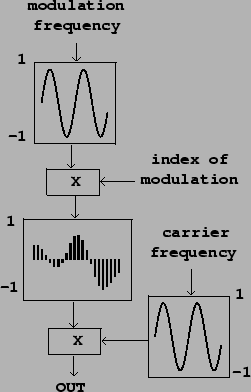
In the previous chapter (see figure 5.4, page ![[*]](file:/usr/local/share/lib/latex2html/icons/crossref.png) ),
we showed how to use ring modulation to modify the spectrum of a
periodic signal, placing spectral peaks in specified locations. To
do so we need to be able to generate periodic signals whose spectra
have maxima at DC and fall off monotonically with increasing
frequency. If we can make a signal with a formant at frequency
zero--and no other formants besides that one--we can use ring
modulation to displace the formant to any desired harmonic. The
ring modulation product will be of the form
),
we showed how to use ring modulation to modify the spectrum of a
periodic signal, placing spectral peaks in specified locations. To
do so we need to be able to generate periodic signals whose spectra
have maxima at DC and fall off monotonically with increasing
frequency. If we can make a signal with a formant at frequency
zero--and no other formants besides that one--we can use ring
modulation to displace the formant to any desired harmonic. The
ring modulation product will be of the form
![\begin{displaymath} x[n] = \cos(\omega_c n) f (a \cos(\omega_m n)) \end{displaymath}](img577.png)
 (the carrier frequency) is set to the formant center
frequency and
(the carrier frequency) is set to the formant center
frequency and
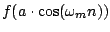 is a signal with
fundamental frequency
is a signal with
fundamental frequency  , produced using a
waveshaping function
, produced using a
waveshaping function  and index
  .
This second term is the signal we wish to give a formant at DC with
a controllable bandwidth. A block diagram for synthesizing this
signal is shown in Figure 6.2.
.
This second term is the signal we wish to give a formant at DC with
a controllable bandwidth. A block diagram for synthesizing this
signal is shown in Figure 6.2.
Much earlier in section 2.4 we introduced the technique
of timbre stretching, as part
of the discussion of wavetable synthesis. This technique, which is
capable of generating complex, variable timbres, can be fit into
the same framework. The enveloped wavetable output for one cycle
is:

 , the phase, satisfies
 . Here
  is a function stored in a wavetable,
  is a windowing
function, and
is a windowing
function, and  and are the wavetable
stretching and a modulation index for the enveloping wavetable.
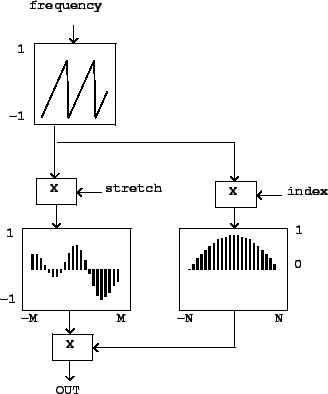
Figure 6.3 shows how to realize this in
block diagram form. Comparing this to figure 2.7, we see that the only significant
new feature is the addition of an index to the waveshaping
function.
and are the wavetable
stretching and a modulation index for the enveloping wavetable.
Figure 6.3 shows how to realize this in
block diagram form. Comparing this to figure 2.7, we see that the only significant
new feature is the addition of an index to the waveshaping
function.
In this setup, as in the previous one, the first term specifies
the placement of energy in the spectrum--in this case, with the
parameter acting to stretch out the wavetable
spectrum. This is the role that was previously carried out by the
choice of ring modulation carrier frequency .
Both of these (ring modulated waveshaping and stretched
wavetable synthesis) can be considered as particular cases of a
more general approach which is to compute functions of the
form,
![\begin{displaymath} x[n] = c(\omega n) {m_a}(\omega n) \end{displaymath}](img584.png) is a periodic function describing the
carrier signal, and
is a periodic function describing the
carrier signal, and  is a periodic modulator
function which depends on an index . The modulation
functions we're interested in will usually take the form of pulse
trains, and the index will control the width of the
pulse; higher values of will give narrower pulses. In
the wavetable case, the modulation function must reach zero at
phase wraparound points to suppress any discontinuities in the
carrier function when the phase wraps around. The carrier signal
will give rise to a single spectral peak (a formant) in the ring
modulated waveshaping case; for wavetables, there may be a much
more complicated spectrum.
is a periodic modulator
function which depends on an index . The modulation
functions we're interested in will usually take the form of pulse
trains, and the index will control the width of the
pulse; higher values of will give narrower pulses. In
the wavetable case, the modulation function must reach zero at
phase wraparound points to suppress any discontinuities in the
carrier function when the phase wraps around. The carrier signal
will give rise to a single spectral peak (a formant) in the ring
modulated waveshaping case; for wavetables, there may be a much
more complicated spectrum.
In the next section we will further develop the two forms of modulating signal we've introduced here, and in the following one we'll look more closely at the carrier signal.