


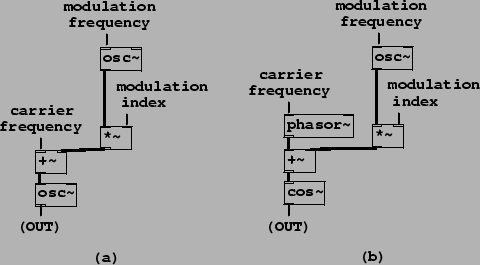
Example E08.phase.mod.pd, shown in Figure 5.15, shows how to use Pd to realize true frequency
modulation (part a) and phase modulation (part b). These correspond
to the block diagrams of Figure 5.8. To accomplish phase modulation, the
carrier oscillator is split into its phase and cosine lookup
components. The signal is of the form
![\begin{displaymath} x[t] = \cos( \omega_c n + a \cos(\omega_m n)) \end{displaymath}](img529.png)
 is the carrier frequency,
 is the modulation frequency, and
 is the index of modulation--all in angular
units.
is the index of modulation--all in angular
units.
We can predict the spectrum by expanding the outer
cosine:
![\begin{displaymath} x[t] = \cos( \omega_c n ) \cos (a \cos(\omega_m n)) - \sin( \omega_c n ) \sin (a \cos(\omega_m n)) \end{displaymath}](img531.png)
![\begin{displaymath} x[t] = {J_0}(a) \cos( \omega_c n ) \end{displaymath}](img532.png)


 with sidebands extending in either
direction, each spaced from the next. The
amplitudes are functions of the index of modulation, and don't
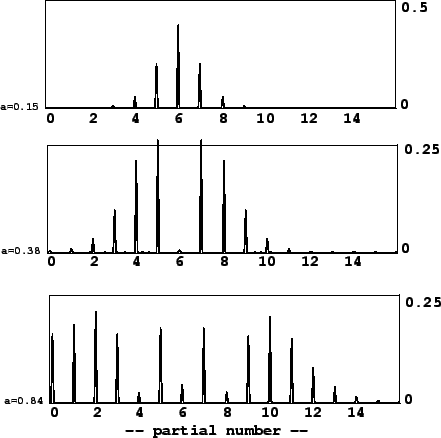
depend on the frequencies. Figure 5.16
shows some two-operator phase modulation spectra, measured using
Example E09.FM.spectrum.pd.
with sidebands extending in either
direction, each spaced from the next. The
amplitudes are functions of the index of modulation, and don't
depend on the frequencies. Figure 5.16
shows some two-operator phase modulation spectra, measured using
Example E09.FM.spectrum.pd.
 |
Phase modulation can thus be seen simply as a form of ring modulated waveshaping. So we can use the strategies described in Section 5.2 to generate particular combinations of frequencies. For example, if the carrier frequency is half the modulation frequency, you get a sound with odd harmonics exactly as in the octave dividing example (5.5).
Frequency modulation need not be restricted to purely sinusoidal
carrier or modulation oscillators. One well-trodden path is to
effect phase modulation on the phase modulation spectrum itself.
There are then two indices of modulation (call them and
 ) and two frequencies of modulation
( and
) and two frequencies of modulation
( and  ) and
the waveform is:
) and
the waveform is:
![\begin{displaymath} x[n] = \cos(\omega_c n + a \cos(\omega_m n) + b \cos(\omega_p n)) \end{displaymath}](img538.png)
 everywhere with
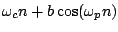 . The third
positive sideband becomes for instance:
. The third
positive sideband becomes for instance:

 and phase
  [Leb77].
Example E10.complex.FM.pd (not shown here) illustrates this by
graphing spectra from a two-modulator FM instrument.
[Leb77].
Example E10.complex.FM.pd (not shown here) illustrates this by
graphing spectra from a two-modulator FM instrument.
Since early times [Sch77] researchers have sought combinations of phases, frequencies, and modulation indices, for simple and compact phase modulation instruments, that manage to imitate familiar instrumental sounds. This became a major industry with the introduction of commercial FM synthesizers.
 radians.