


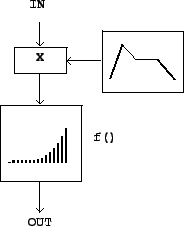
Another approach to modulating a signal, called waveshaping, is simply to pass it through a
suitably chosen nonlinear function. A block diagram for doing this
is shown in Figure 5.5. The
function  (called the transfer function) distorts the incoming waveform
into a different shape. The new shape depends on the shape of the
incoming wave, on the transfer function, and finally on the
amplitude of the incoming signal. Since the amplitude of the input
waveform affects the shape of the output waveform (and hence the
timbre), this gives us an easy way to make a continuously varying
family of timbres, simply by varying the input level of the
transformation. For this reason, it is customary to include a
leading amplitude control as part of the waveshaping operation, as
shown in the block diagram.
(called the transfer function) distorts the incoming waveform
into a different shape. The new shape depends on the shape of the
incoming wave, on the transfer function, and finally on the
amplitude of the incoming signal. Since the amplitude of the input
waveform affects the shape of the output waveform (and hence the
timbre), this gives us an easy way to make a continuously varying
family of timbres, simply by varying the input level of the
transformation. For this reason, it is customary to include a
leading amplitude control as part of the waveshaping operation, as
shown in the block diagram.
 |
The amplitude of the sinusoid is called the waveshaping index. In many situations a small index leads to relatively little distortion (hence a more nearly sinusoidal output) and a larger one gives a more distorted, hence richer, timbre.
Figure 5.6 shows a familiar
example of waveshaping, in which the amounts to a
clipping function. This
example shows clearly how the input amplitude--the index--can
affect the output waveform. The clipping function passes its input
to the output unchanged as long as it stays in the interval between
-0.3 and +0.3. So when the input (in this case a sinusoid) does not
exceed 0.3 in absolute value, the output is the same as the input.
But when the input grows past the 0.3 limit, it is limited to 0.3;
and as the amplitude of the signal increases the effect of this
clipping action is progressively more severe. In the figure, the
input is a decaying sinusoid. The output evolves from a nearly
square waveform at the beginning to a pure sinusoid at the end.
This effect will be well known to anyone who has played an
instrument through an overdriven amplifier. The louder the input,
the more distorted will be the output. For this reason, waveshaping
is also sometimes called
distortion.
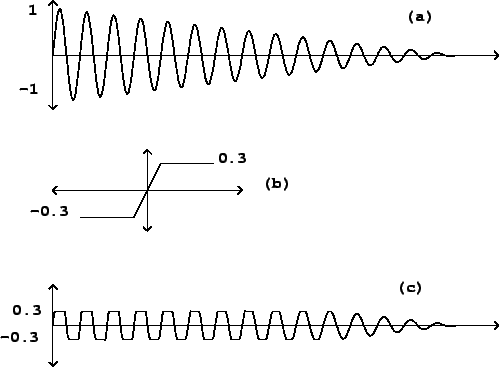 |
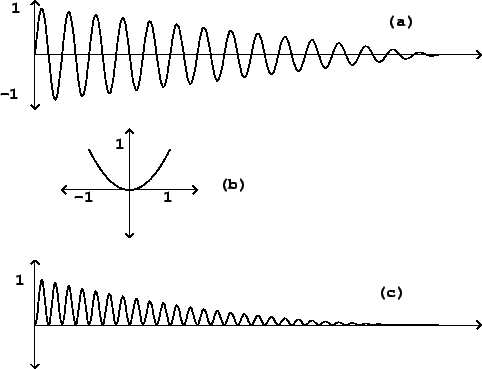
Figure 5.7 shows a much
simpler and easiest to analyse situation, in which the transfer
function simply squares the input:

![\begin{displaymath} x[n] = a \cos(\omega n + \phi) \end{displaymath}](img420.png)
![\begin{displaymath} f(x[n]) = {{a^2} \over 2} \left ( 1 + \cos(2 \omega n + 2 \phi) \right ) \end{displaymath}](img421.png)
 equals one, this just amounts to ring
modulating the sinusoid by a sinusoid of the same frequency, whose
result we described in the previous section: the output is a CD
signal plus a signal at twice the original frequency. However,
unlike the case of ring modulation, the amplitude of the output
grows as the square of the input.
equals one, this just amounts to ring
modulating the sinusoid by a sinusoid of the same frequency, whose
result we described in the previous section: the output is a CD
signal plus a signal at twice the original frequency. However,
unlike the case of ring modulation, the amplitude of the output
grows as the square of the input.
 |
Keeping the same transfer function, we now consider the effect
of sending in a combination of two sinusoids with amplitudes
and  , and angular
frequencies
, and angular
frequencies  and
and  . For
simplicity, we'll omit the initial phase terms. We set:
. For
simplicity, we'll omit the initial phase terms. We set:
![\begin{displaymath} x[n] = a \cos(\alpha n) + b \cos(\beta n) \end{displaymath}](img423.png)
 gives
gives![\begin{displaymath} f(x[n]) = {{a^2} \over 2} \left ( 1 + \cos(2 \alpha n) \right ) \end{displaymath}](img424.png)
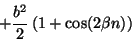


 sinusoids in the input there are only
``straight" terms in the product, but there
are
sinusoids in the input there are only
``straight" terms in the product, but there
are  intermodulation terms.
As compared to ring modulation, which is linear in its input, waveshaping is nonlinear. While we were able to analyze linear processes by considering their action separately on all the components of the input, in this nonlinear case we also have to consider the interactions between components. The results are far more complex--sometimes sonically much richer, but, on the other hand, harder to understand or predict.
In general, we can show that a periodic input, no matter how
complex, will give an output of the same periodicity. If the period
is  so that
![\begin{displaymath} x[n + \tau] = x[n] \end{displaymath}](img100.png)
![\begin{displaymath} f(x[n+\tau]) = f(x[n]) . \end{displaymath}](img429.png)
 and
and  are a musical fourth
apart (periods in the ratio 4:3), then the sum of the two repeats
at the lower rate given by the common subharmonic. In equations we
would have:
are a musical fourth
apart (periods in the ratio 4:3), then the sum of the two repeats
at the lower rate given by the common subharmonic. In equations we
would have:![\begin{displaymath} x[t + \tau/3] = x[t] \end{displaymath}](img430.png)
![\begin{displaymath} y[t + \tau/4] = y[t] \end{displaymath}](img431.png)
![\begin{displaymath} x[t + \tau] + y[t+\tau] = x[t] + y[t] \end{displaymath}](img432.png)
 would repeat after a
period of :
would repeat after a
period of :![\begin{displaymath} f(x+y)[n + \tau] = f(x+y)[n]. \end{displaymath}](img434.png)
To get a somewhat more explicit analysis of the effect of
waveshaping on an incoming signal, it is sometimes useful to write
the function as a finite or infinite polynomial
series:

![$x[n]$](img28.png) is a sinusoid
is a sinusoid
 , we can consider the action
of the above terms separately:
, we can consider the action
of the above terms separately:![\begin{displaymath} f(x[n]) = {f_0} + a {f_1}\cos(\omega n) + {a^2} {f_2} {\cos^2} (\omega n) + {a^3} {f_3} {\cos^3} (\omega n) + \cdots \end{displaymath}](img437.png) , a lower value of will
weight the earlier terms more heavily, and a higher value will make
the higher-order terms more prominent.
, a lower value of will
weight the earlier terms more heavily, and a higher value will make
the higher-order terms more prominent.
The individual terms' spectra can be found by applying the
cosine product formula repeatedly:

![\begin{displaymath} x[n] = \cos (\omega n) \end{displaymath}](img439.png)
![\begin{displaymath} {x^2}[n] = {1 \over 2} + {1 \over 2} \cos (2\omega n) \end{displaymath}](img440.png)
![\begin{displaymath} {x^3}[n] = {1 \over 4} \cos (-\omega n) + {2 \over 4} \cos (\omega n) + {1 \over 4} \cos (3 \omega n) \end{displaymath}](img441.png)
![\begin{displaymath} {x^4}[n] = {1 \over 8} \cos (-2\omega n) + {3 \over 8} \cos... ... {3 \over 8} \cos (2 \omega n) + {1 \over 8} \cos (4 \omega n) \end{displaymath}](img442.png)
![\begin{displaymath} {x^5}[n] = {1 \over 16} \cos (-3\omega n) + {4 \over 16} \c... ... \over 16} \cos (3 \omega n) + {1 \over 16} \cos (5 \omega n) \end{displaymath}](img443.png)
 term of the expansion, grows as the
square root of .
term of the expansion, grows as the
square root of .
The negative-frequency terms (which have been shown separately here for clarity) are to be combined with the positive ones; the spectral envelope is folded into itself in the same way as in the ring modulation example of Figure Figure 5.4.
As long as the coefficients  are all positive
numbers or zero, then so are all the amplitudes of the sinusoids in
the expansions above. In this case all the phases stay coherent as
varies and so we get a widening of the
spectrum (and possibly a drastically increasing amplitude) with
increasing values of . On the other hand, if some of
the are positve and others negative, the
different expansions will interfere destructively; this will give a
more complicated-sounding spectral evolution.
are all positive
numbers or zero, then so are all the amplitudes of the sinusoids in
the expansions above. In this case all the phases stay coherent as
varies and so we get a widening of the
spectrum (and possibly a drastically increasing amplitude) with
increasing values of . On the other hand, if some of
the are positve and others negative, the
different expansions will interfere destructively; this will give a
more complicated-sounding spectral evolution.
Note also that the successive expansions all contain only even
or only odd partials. If the transfer function (in series form)
happens to contain only even powers:

 , then the output will contain
only odd partials. Even if can't be expressed
exactly as a power series (for example, the clipping function of
Figure 5.3), it is still true
that if is an even function, i.e., if
, then the output will contain
only odd partials. Even if can't be expressed
exactly as a power series (for example, the clipping function of
Figure 5.3), it is still true
that if is an even function, i.e., if is an odd
function,
is an odd
function,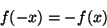
Many mathematical tricks have been proposed to use waveshaping to generate specified spectra. It turns out that you can generate pure sinusoids at any harmonic of the fundamental by using a Chebyshef polynomial as a transfer function [Leb79], and from there you can go on to build any desired static spectrum. Generating families of spectra by waveshaping a sinusoid of variable amplitude turns out to be trickier, although several interesting special cases have been found, one of which is developed here in chapter [].
 .
The input (a) yields an output (c) at twice the
frequency.
.
The input (a) yields an output (c) at twice the
frequency.