


In the wavetable formulation, the pulse train can be made by a
stretched wavetable:
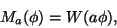
 is the phase. The
function
is the phase. The
function  should be zero at and beyond the points
 and
and  , and rise to a
maximum at 0. A possible choice for the function
is
, and rise to a
maximum at 0. A possible choice for the function
is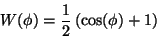
![[*]](file:/usr/share/latex2html/icons/crossref.png) .
.
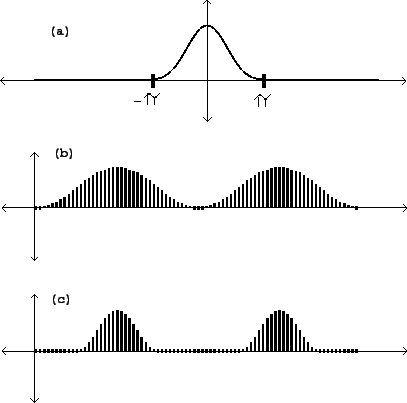 |
Realizing this as a repeating waveform, we get a succession of
(appropriately sampled) copies of the function ,
whose duty cycle is  (parts b and c of the
figure). If you don't wish the copies to overlap we require
(parts b and c of the
figure). If you don't wish the copies to overlap we require
 to be at least 1. If you want overlap the
best strategy is to duplicate the block diagram (Figure 6.3) out of phase, as described in
Section 2.4 and realized
in Section 2.6.5.
to be at least 1. If you want overlap the
best strategy is to duplicate the block diagram (Figure 6.3) out of phase, as described in
Section 2.4 and realized
in Section 2.6.5.
In the ring modulated waveshaping formulation, the shape of the
formant is determined by a modulation term
![\begin{displaymath} m[n] = f (a \cos(\omega_m n)) \end{displaymath}](img575.png) , the modulation term
varies only slightly from the constant value
, the modulation term
varies only slightly from the constant value  , so most of the energy is concentrated at DC. As
increases, the energy spreads out among
progressively higher harmonics of the fundamental
, so most of the energy is concentrated at DC. As
increases, the energy spreads out among
progressively higher harmonics of the fundamental  . Depending on the function
  , this
spread may be orderly or disorderly. An orderly spread may be
desirable and then again may not, depending on whether our goal is
a predictable spectrum or a wide range of different (and perhaps
hard-to-predict) spectra.
, this
spread may be orderly or disorderly. An orderly spread may be
desirable and then again may not, depending on whether our goal is
a predictable spectrum or a wide range of different (and perhaps
hard-to-predict) spectra.
A waveshaping function that gives well-behaved, simple and
predictable results was already developed in section 5.5.5. Using the
function
 (and
taking the renormalization into account) gives:
(and
taking the renormalization into account) gives:
![\begin{displaymath} = e ^ { { -\left [ b \sin {\omega \over 2} \right ] } ^2 } \end{displaymath}](img578.png)
 so that
  is
proportional to the bandwidth. This can be rewritten as
is
proportional to the bandwidth. This can be rewritten as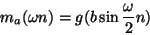

Another good choice is the (again unnormalized) Cauchy
distribution:


 and
and  are functions of
the index (exact formulas are given in []).
are functions of
the index (exact formulas are given in []).
In both this and the Gaussian case above, the bandwidth (counted
in peaks, i.e., units of  ) is roughly proportional
to the index , and the amplitude of the DC term (the
peak of the spectrum) is roughly proportional to
) is roughly proportional
to the index , and the amplitude of the DC term (the
peak of the spectrum) is roughly proportional to  . For either waveshaping function (
 or
or  ), if is larger than about
2, the waveshape of
), if is larger than about
2, the waveshape of
 is approximately a (forward
or backward) scan of the transfer function, and so this and the
earlier example (the ``wavetable formulation") both look like
pulses whose widths decrease as the specified bandwidth
increases.
is approximately a (forward
or backward) scan of the transfer function, and so this and the
earlier example (the ``wavetable formulation") both look like
pulses whose widths decrease as the specified bandwidth
increases.
Before considering more complicated carrier signals to go with
the modulators we've seen so far, it is instructive to see what
multiplication by a pure sinusoid gives us as waveforms and
spectra. Figure 6.5 shows the
result of multiplying two different pulse trains by a sinusoid at
the sixth partial:
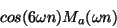 is two in both cases.
In part (a)
is two in both cases.
In part (a)  is the stretched Hanning windowing
function; part (b) shows waveshaping via the unnormalized Cauchy
distribution. One period of each waveform is shown.
is the stretched Hanning windowing
function; part (b) shows waveshaping via the unnormalized Cauchy
distribution. One period of each waveform is shown.
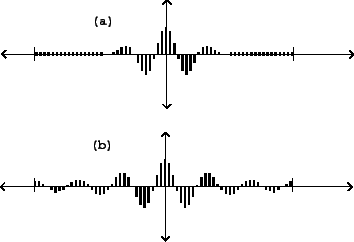 |
In both cases we see, in effect, the sixth harmonic (the carrier signal) enveloped into a wave packet centered at the middle of the cycle, where the phase of the sinusoid is zero. Changing the frequency of the sinusoid changes the center frequency of the formant; changing the width of the packet (the proportion of the waveform during which the sinusoid is strong) changes the bandwidth. Note that the stretched Hanning window function is zero at the beginning and end of the period, unlike the waveshaping packet.
Figure 6.6 shows how the specific shape of the formant depends on the method of production. The stretched wavetable form (part (a) of the figure) behaves well in the neighborhood of the peak, but somewhat oddly starting at four partials' distance from the peak, past which we see what are called sidelobes: spurious extra peaks at lower amplitude than the central peak. As the analysis of Section 2.4 predicts, the entire formant, sidelobes and all, stretches or contracts inversely as the pulse train is contracted or stretched in time.
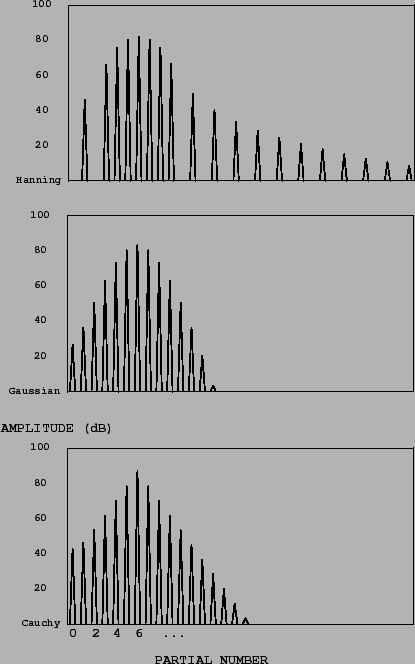 |
The first, strongest sidelobes on either side are about 37 dB lower in amplitude than the main peak. Further sidelobes drop off slowly when expressed in decibels; the amplitudes decrease as the square of the distance from the center peak so that the sixth sidelobe to the right, three times further than the first one from the center frequency, is about twenty decibels further down. The effect of these sidelobes is often audible as a slight buzziness in the sound.
This formant shape may be made arbitrarily fat (i.e., high bandwidth), but there is a limit on how thin it can be made, since the duty cycle of the waveform cannot exceed 100%. At this maximum duty cycle the formant strength drops to zero at two harmonics' distance from the center peak. If a still lower bandwidth is needed, waveforms may be made to overlap as described in section 2.6.5.
Parts (b) and (c) of the figure show formants generated using ring modulated waveshaping, with Gaussian and Cauchy transfer functions. The index of modulation is two in both cases (the same as for the Hanning window of part (a)), and the bandwidth is comparable to that of the Hanning example. In these examples there are no sidelobes, and moreover, the index of modulation may be dropped all the way to zero, giving a pure sinusoid; there is no lower limit on bandwidth. On the other hand, since the waveform does not reach zero at the ends of a cycle, this type of pulse train cannot be used to window an arbitrary wavetable, as the Hanning pulse train could.
The Cauchy example is particularly easy to build designer spectra from, since the shape of the formant is a perfect Isosocles triangle, when graphed in decibels. On the other hand, the Gaussian example gathers more energy to the neighborhood of the formant, and drops off faster at the tails, and so has a cleaner sound.
 ; b. the function
repeated at a duty cycle of 100% (modulation index
; b. the function
repeated at a duty cycle of 100% (modulation index  ); c. the function at a 50% duty cycle (
 ).
).