Recall the formula for a (real-valued) sinusoid from page
![[*]](file:/usr/share/latex2html/icons/crossref.png) :
:
![\begin{displaymath} x[n] = a \cos(\omega n + \phi) \end{displaymath}](img449.png)
 .
The cosines are all adjusted by the factor
.
The cosines are all adjusted by the factor  . We can
now re-write this as the real part of a much simpler and easier to
manipulate sequence of complex numbers, by using the properties of
their arguments and magnitudes.
. We can
now re-write this as the real part of a much simpler and easier to
manipulate sequence of complex numbers, by using the properties of
their arguments and magnitudes.
Suppose that our complex number  happens to
have magnitude one, so that it can be written as:
happens to
have magnitude one, so that it can be written as:
 , the number
  must have magnitude one as well (because magnitudes multiply) and
argument
must have magnitude one as well (because magnitudes multiply) and
argument  (because arguments add). So,
 , so for
example,
, so for
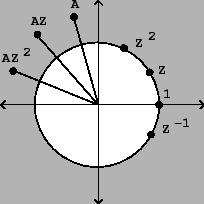
example, wrap around the unit circle, which is
the set of all complex numbers of magnitude one. They form a
geometric sequence:
wrap around the unit circle, which is
the set of all complex numbers of magnitude one. They form a
geometric sequence: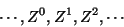

Furthermore, suppose we multiply the elements of the sequence by
some (complex) constant  with magnitude and argument
  . This gives
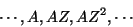 and the argument of the
th term is
and the argument of the
th term is
 , so the sequence is equal
to
, so the sequence is equal
to![\begin{displaymath} a \cdot [\cos(\phi) + i \sin(\phi)], \end{displaymath}](img675.png)
![\begin{displaymath} a \cdot [\cos(\omega + \phi) + i \sin(\omega + \phi)], \end{displaymath}](img676.png)
![\begin{displaymath} \cdots , a \cdot [\cos(n \omega + \phi) + i \sin(n \omega + \phi)], \cdots \end{displaymath}](img677.png)
![\begin{displaymath} \mathrm{re}(A{Z^n}) = a \cdot [\cos(n \omega + \phi)] \end{displaymath}](img678.png) encodes both the amplitude
(equal to its magnitude ) and the inital phase (its
argument ); the unit-magnitude complex number
controls the frequency which is just its
argument
encodes both the amplitude
(equal to its magnitude ) and the inital phase (its
argument ); the unit-magnitude complex number
controls the frequency which is just its
argument  .
.
Figure 7.2 also shows the
sequence
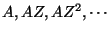 ; in effect this is the
same sequence as
; in effect this is the
same sequence as
 , but amplified and
rotated according to the amplitude and initial phase. In a complex
sinusoid of this form, is called the complex amplitude.
, but amplified and
rotated according to the amplitude and initial phase. In a complex
sinusoid of this form, is called the complex amplitude.
Using complex numbers to represent the amplitudes and phases of
sinusoids can clarify manipulations that otherwise might seem
unmotivated. For instance, in Section 1.6 we considered the sum of two
sinusoids with the same frequency. In the language of this chapter,
we let the two sinusoids be written as:
![\begin{displaymath} X[n] = A {Z^n} , \ Y[n] = B {Z^n} \end{displaymath}](img681.png) and
and  encode the phases
and amplitudes of the two signals. The sum is then equal to:
encode the phases
and amplitudes of the two signals. The sum is then equal to:![\begin{displaymath} X[n] + Y[n] = (A+B) {Z^n} \end{displaymath}](img682.png)
 and whose phase equals
 . This is clearly a much
easier way to manipulate amplitudes and phases than using series of
sines and cosines. Eventually, of course, we will take the real
part of the result; this can usually be left to the very last step
of the calculation.
. This is clearly a much
easier way to manipulate amplitudes and phases than using series of
sines and cosines. Eventually, of course, we will take the real
part of the result; this can usually be left to the very last step
of the calculation.
 ,
and the same sequence multiplied by a constant
,
and the same sequence multiplied by a constant